


Bitcoin Stays Calm Despite Iran Strikes — But Volatility Is Coming
Bitcoin held steady as fresh Iran strikes failed to trigger panic selling. Here’s what the muted reaction means and why traders should brace for volatility this...

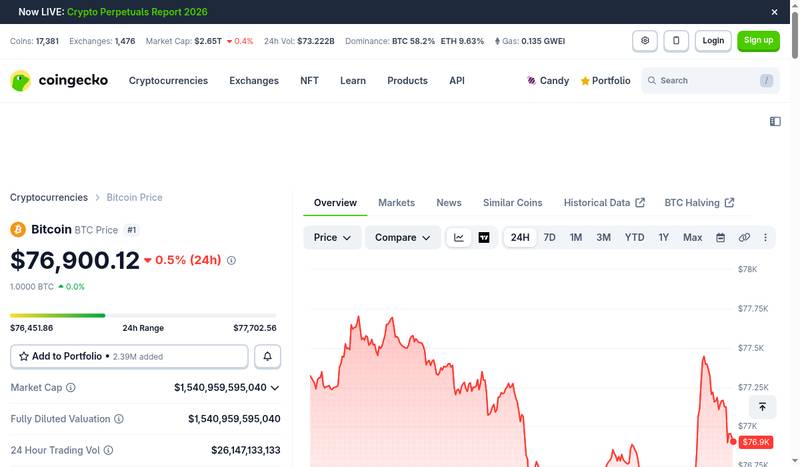
Bitcoin held steady near $76,900 after fresh U.S. military strikes on Iranian missile sites failed to trigger the kind of panic selling that geopolitical shocks have historically unleashed on crypto markets, but a packed macro calendar this week could shatter the calm.
Iran Strikes Came and Went, Bitcoin Barely Flinched
The U.S. military carried out what it described as “self-defense” strikes in southern Iran, targeting missile launch sites and boats placing mines during the ongoing ceasefire. Iran vowed retaliation, and Brent crude climbed in response.
Bitcoin’s reaction was conspicuously muted. The largest cryptocurrency traded at $76,992 with just a 0.35% decline over 24 hours, its price pinned in a narrow $76,451 to $77,702 range.
Compare that to previous Middle East escalations. The April 2024 Iran-Israel missile exchange triggered a brief but sharp BTC dip before a full recovery within days. This time, spot markets absorbed the news with minimal disruption, even as equities traded mixed and oil rebounded.
Calm on the Surface, Tension Underneath
The muted price action does not mean traders are complacent. Market-wide crypto futures open interest held above $130 billion for four consecutive days, while over $400 million in leveraged futures were liquidated, with shorts comprising the majority. Traders are hedging, not fleeing.
Institutional flows tell a different story. U.S. spot Bitcoin ETFs bled $1.26 billion last week and $2.54 billion cumulatively over two consecutive weeks, the second-largest weekly outflow run of 2026. Similar to the broader pattern of institutional repositioning around Bitcoin options products, the outflows reflect a deliberate risk rotation rather than panic.
James Butterfill, Head of Research at CoinShares, said the Iran-related risk-off “has deepened and broadened despite continued CLARITY Act progress.”
Crypto Fear & Greed Index
Fear
Sentiment remains cautious but not panicked — market absorbed Iran strike headlines without a selloff. Source: Alternative.me
Glassnode noted that ETF outflows have continued nearly every trading day since May 7, calling it a persistent institutional sell signal running for more than two weeks. Swissblock’s Bitcoin risk index sits at 33 out of 100, deep in high-risk territory. The pattern echoes the kind of large-scale exchange outflows seen across major tokens this month.
What Could Break the Calm This Week
Thursday’s PCE inflation report, the Fed’s preferred price gauge, is the week’s primary macro catalyst. A hot reading would reinforce the hawkish trajectory that has already reshaped rate expectations. Goldman Sachs has delayed its first expected Fed rate cut to December 2026, while Bank of America expects no cuts at all this year.
Traders are now pricing a 40% probability of a 25 basis point hike in December 2026, with markets fully pricing one by January 2027. For Bitcoin, which remains roughly 39% below its all-time high of $126,080 set in October 2025, higher-for-longer rates squeeze the liquidity conditions that fueled last year’s rally.
On the geopolitical front, any Iranian retaliation would test whether spot markets can absorb a second shock. According to unconfirmed reports, the U.S. and Iran have discussed a plan to open the Strait of Hormuz roughly 30 days from a final deal, which could ease oil-driven risk-off pressure if confirmed.
BTC needs to reclaim the $77,500 to $78,000 zone to target $80,000, according to one unverified analyst estimate. On the downside, a break below $76,000 with sustained ETF outflows could accelerate selling. With Bitcoin’s market cap at $1.54 trillion and 95.4% of the 21 million hard cap already mined, supply-side dynamics leave little buffer if whale positioning shifts decisively.
Tuesday’s next round of ETF flow data will be the first real-time verdict on whether the $2.54 billion outflow streak is deepening or stabilizing. Thursday’s PCE print follows. Both could determine whether Bitcoin’s composure holds, or whether the volatility the derivatives market is pricing finally arrives in spot.
Disclaimer: This article is for informational purposes only and does not constitute financial or investment advice. Cryptocurrency and digital asset markets carry significant risk. Always do your own research before making decisions.
More From Market

Strait of Hormuz Shipping Attack Raises Oil Supply Fears
An attack on Strait of Hormuz shipping has renewed fears for oil supplies, according to unconfirmed reports, though the specific incident behind the headline re...

Block EPS Jumps 65%, Stock Falls Despite Strong Earnings
Block reported a 65% surge in earnings per share, yet its stock fell in the wake of the results, a disconnect that made market sentiment, rather than the headli...

BTC Price Warning: 4 Reasons Bitcoin Could Drop Next Week
This BTC price warning centers on a single decision level: Bitcoin has struggled to maintain the $65,000 mark, and a four-part downside setup has traders watchi...

Crypto Price Analysis July 24: ETH, XRP, ADA, BNB, HYPE
Ethereum is the only asset in this group with a defined weekly move, up 3% but pressing into resistance, according to CryptoPotato’s July 24 price analysis . Th...

FT report: London Stock Exchange plans round-the-clock trading
The London Stock Exchange is looking at moving to round-the-clock trading, the Financial Times reported . In practice, that would mean shares could be bought an...

Bitcoin Price Analysis: BTC Bearish Below Key Reclaim
Bitcoin’s market structure remains bearish, with BTC unable to reclaim a key resistance level that would shift momentum back in favor of bulls. Until that level...

Author
Akita Inu
Akita Inu covers fast-moving crypto market updates, exchange news, and token ecosystem developments for CoinLive, with a focus on concise source-led reporting.