


Bitcoin Mining Difficulty Tops 100T Hash for the First Time
Key Points: Bitcoin mining difficulty surpasses 100T for the first time with an average hashrate peaking at 840 EH/s. High mining difficulty inadvertently puts...
Key Points:
- Bitcoin mining difficulty surpasses 100T for the first time with an average hashrate peaking at 840 EH/s.
- High mining difficulty inadvertently puts greater selling pressure on smaller miners.
New ATH for Bitcoin’s average hashrate, combined with Bitcoin mining difficulty surpassing 100 trillion hashes, is adding selling pressure on small miners.
Bitcoin Mining Difficulty Reaches All-Time High
According to data from blockchain tracking tool Mempool, the Bitcoin (BTC) mining difficulty has reached an all-time high of 101.65 trillion (T) hash, equivalent to a 17.6% increase in the past 6 months since the last record.
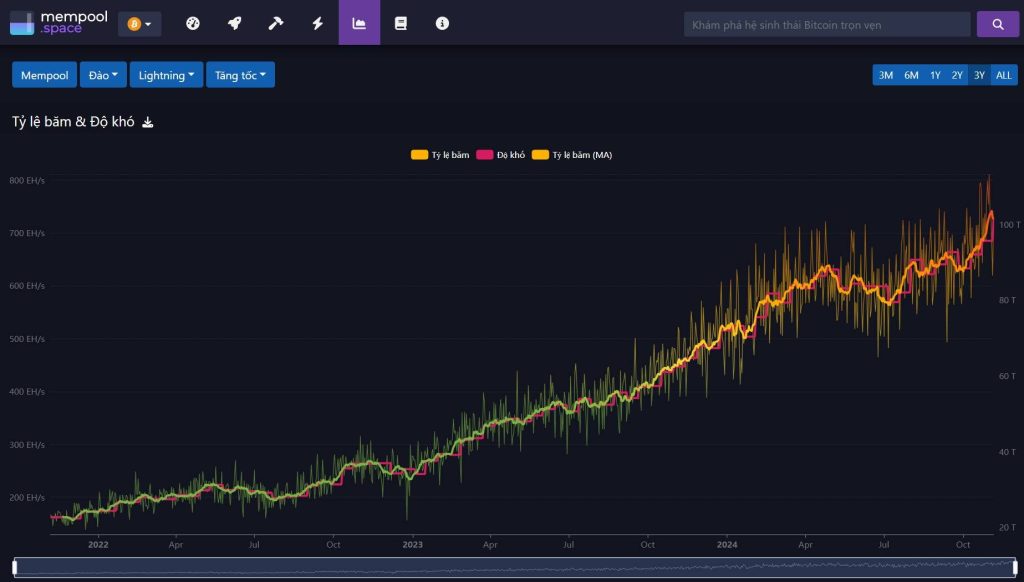
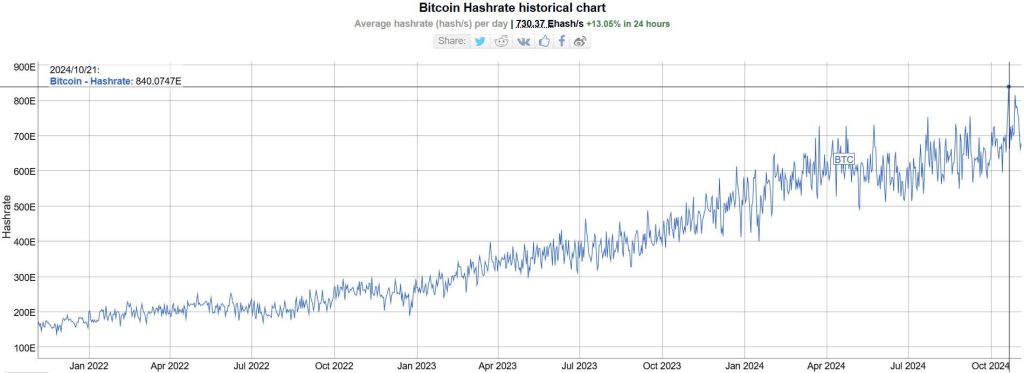
Along with the mining difficulty, the Bitcoin network hashrate also set a new record when it exceeded 800 EH/s, with times “jumping” to 840.07 EH/s on October 21, 2024.
Increased Difficulty Places Strain on Smaller Miners
The Bitcoin mining algorithm difficulty is a concept that refers to a self-adjusting mechanism of the world’s largest cryptocurrency network. Accordingly, the mining algorithm will be changed every 2,016 blocks (about 2 weeks) to maintain the block generation time around the target of 10 minutes. If the hashrate increases, indicating that more miners are operating, the system will increase the difficulty, and vice versa.
This year, Bitcoin’s hashrate and mining difficulty has continuously set new records, especially after the 4th halving event, which caused the reward to be “halved” to 3.125 BTC, making the mining process even more difficult. The higher the difficulty, the greater the pressure on the mining industry to produce a block.
This inadvertently increases selling pressure on smaller miners. Because coin mining is an extremely competitive and capital-intensive industry, small or private companies that are limited in cash compared to their publicly traded rivals may be forced to sell the amount of Bitcoin they mine to fund operations.
As of November 5th, data from MacroMicro shows that the cost to mine 1 Bitcoin has increased to $82,386, while the price of Bitcoin fluctuates around $68,800. This causes miners to lose an average of more than $13,000 for every BTC mined.
Currently, miners mine about 450 Bitcoins per day. On average, they have to sell 100% of the total amount of Bitcoin mined, meaning that every day, there is selling pressure equivalent to about 31 million USD.
| DISCLAIMER: The information on this website is provided as general market commentary and does not constitute investment advice. We encourage you to do your own research before investing. |
Source: Coincu
More From Market
USDT to BTC Exchange 2026: Best Rate With ChangeNOW and Alternatives
USDT to BTC in 2026: ChangeNOW, Swapzone, and StealthEX compared by rate spread, settlement time, and no-KYC limits. Fixed vs floating rate guide included.

Strait of Hormuz Shipping Attack Raises Oil Supply Fears
An attack on Strait of Hormuz shipping has renewed fears for oil supplies, according to unconfirmed reports, though the specific incident behind the headline re...

Block EPS Jumps 65%, Stock Falls Despite Strong Earnings
Block reported a 65% surge in earnings per share, yet its stock fell in the wake of the results, a disconnect that made market sentiment, rather than the headli...

BTC Price Warning: 4 Reasons Bitcoin Could Drop Next Week
This BTC price warning centers on a single decision level: Bitcoin has struggled to maintain the $65,000 mark, and a four-part downside setup has traders watchi...

Crypto Price Analysis July 24: ETH, XRP, ADA, BNB, HYPE
Ethereum is the only asset in this group with a defined weekly move, up 3% but pressing into resistance, according to CryptoPotato’s July 24 price analysis . Th...

FT report: London Stock Exchange plans round-the-clock trading
The London Stock Exchange is looking at moving to round-the-clock trading, the Financial Times reported . In practice, that would mean shares could be bought an...
