
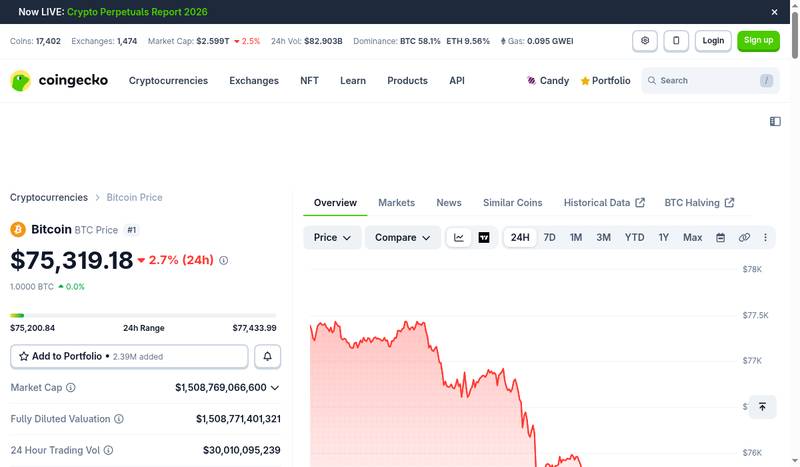
Bitcoin plunged more than 7% from above $82,000 to a low of $75,500 over the weekend, wiping out approximately $5 billion in leveraged long positions and briefly pushing MicroStrategy's entire Bitcoin treasury underwater. The sell-off, driven by a convergence of macro shocks and crypto-native liquidation cascades, has left traders asking whether the worst is over.
TLDR
- BTC crashed from ~$84,000 to $75,500 before partially recovering, with $5 billion in crypto longs liquidated
- Trump's escalating tariff policies and a hawkish Fed Chair nomination triggered the initial risk-off move
- On-chain metrics, including Bitcoin's first breach of the True Market Mean in 30 months, suggest further downside risk remains
Five Drivers Behind Bitcoin's Drop to $75K
1. Trump's Tariff Escalation Spooked Risk Markets
The primary macro trigger was Trump's April executive order imposing sweeping reciprocal tariffs, including a 34% rate on China. The policy shock rippled across equities and crypto alike, pushing traders into risk-off positioning.
2. Kevin Warsh's Fed Chair Nomination Added Hawkish Pressure
According to unconfirmed reports, Trump's nomination of Kevin Warsh to replace Jerome Powell as Federal Reserve Chair introduced additional monetary policy uncertainty. Markets interpreted the pick as a hawkish signal, further pressuring rate-sensitive assets like Bitcoin.
3. A $5 Billion Liquidation Cascade Amplified the Move
Approximately $5 billion in crypto long positions were liquidated over the weekend. ETH accounted for roughly $1.15 billion in liquidations, while Solana saw approximately $200 million wiped out. Funding-rich perpetual contracts met shallow weekend liquidity, turning an orderly decline into a flush.
"A snowball rolling downhill — there are concerns about risk right now."
— Bryan Armour, Director of Passive Strategies Research, Morningstar
4. Bitcoin Broke Below Its True Market Mean for the First Time in 30 Months
BTC fell below the $80,500 True Market Mean, an on-chain valuation metric, for the first time since late 2023 when the price was near $29,000. This breach signals that short-term holders are now deeply underwater on average, a condition historically associated with extended drawdowns.
5. MicroStrategy's Cost Basis Became a Psychological Floor
MicroStrategy holds 712,647 BTC at an average cost basis of $76,037. When Bitcoin touched $75,500, the company's entire position briefly went underwater, raising fears of forced selling. The episode echoes the kind of high-stakes institutional crypto disputes that can rattle market confidence.
Sentiment and Derivatives Signals Still Flash Caution
The Fear & Greed Index hit 16 during the peak of the sell-off, marking the 2026 low and deep "Extreme Fear" territory. It has since recovered slightly to 28, still firmly in "Fear."
Bitcoin currently trades at $75,361, down 2.55% over 24 hours and 4.54% over seven days. The price sits roughly 40% below the all-time high of $126,080 set in October 2025, with the market cap at approximately $1.51 trillion.
Bloomberg Intelligence's Mike McGlone has identified $75,000 as a critical threshold, warning that failure to reclaim this level keeps a bearish path toward $10,000 in play. McGlone noted that unlimited crypto supply and use-case rivals remain Bitcoin headwinds, adding that the most traded BTC price since futures launched in 2017 remains $10,000.
Key Levels and Catalysts to Watch
The $75,000 zone now serves as immediate support, with a breakdown likely opening the door to the $70,000 to $72,000 range. On the upside, reclaiming the True Market Mean at $80,500 would be the first signal that selling pressure is exhausting.
Despite the bearish backdrop, 71% of institutional investors surveyed by Coinbase view BTC as undervalued at the $85,000 to $95,000 range. The disconnect between institutional sentiment and price action mirrors the uncertainty seen across crypto markets, from delayed SEC decisions on tokenized assets to broader liquidity shifts across altcoin markets.
Upcoming FOMC meetings and CPI releases remain the most likely macro catalysts. If tariff escalation pauses and rate expectations soften, $75,000 could hold as a cycle floor. If not, the $70,000 to $72,000 range becomes the next structural support to test.
Disclaimer: This article is for informational purposes only and does not constitute financial or investment advice. Cryptocurrency and digital asset markets carry significant risk. Always do your own research before making decisions.