


TON vs TRON: Telegram-Native Access vs Established Stablecoin Liquidity
A USDT transfer looks simple from the outside. The sender selects a network, enters an address and confirms the transaction. Yet two transfers of the same stabl...
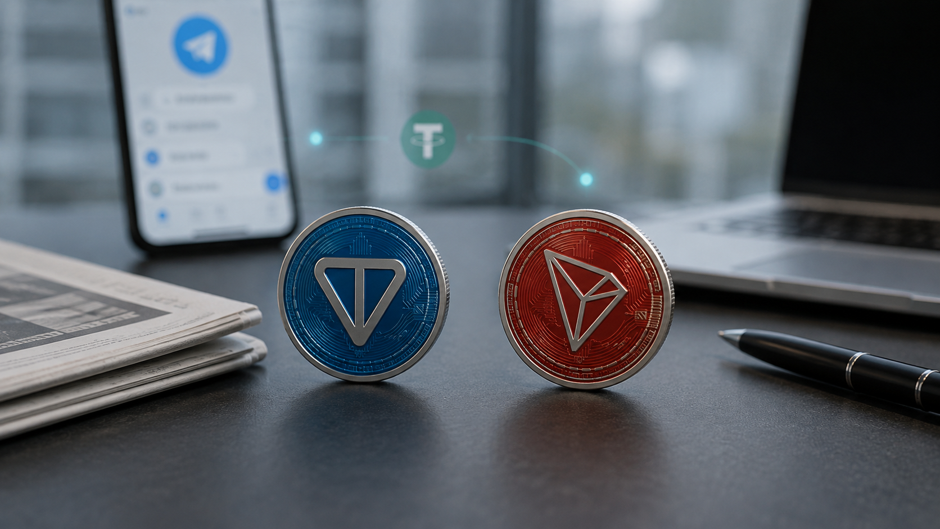
A USDT transfer looks simple from the outside. The sender selects a network, enters an address and confirms the transaction. Yet two transfers of the same stablecoin can follow very different routes depending on the blockchain underneath.
TON and TRON are both widely described as low-cost networks. That label hides the more useful distinction between them. TON is building a stablecoin experience around Telegram, where wallets and blockchain applications can operate inside an interface people already use. TRON has spent years becoming one of the main settlement networks for USDT, with broad support across exchanges, wallets and payment services.
The practical choice is rarely settled by the lowest advertised fee. It depends on where the money starts, where it needs to arrive and what the recipient plans to do with it next.
First, a note on the names
The blockchain is still called TON, short for The Open Network. Its native currency, previously known as Toncoin, was renamed Gram in 2026 and now uses the ticker GRAM. The change did not create a new asset or require holders to migrate their balances. Some exchange interfaces may still reference the former name, using labels such as swap Gram coin (ex Toncoin).
TRON has a similar distinction between its network and native asset:
- TON is the blockchain, while Gram pays its network fees.
- TRON is the blockchain, while TRX is its native asset.
- USDT on TON is issued as a jetton.
- USDT on TRON follows the TRC-20 standard.
The title compares TON and TRON because the subject is the two networks, not their native coins.
The same stablecoin on two separate rails
Tether officially supports USDT on both TON and TRON. The issuer may be the same, but the network versions are technically separate tokens governed by different blockchain standards.
USDT held on TON cannot be sent directly to a TRON deposit address. TRC-20 USDT cannot be credited to a TON address simply because both assets carry the USDT symbol. Moving value between the networks requires an exchange, bridge or conversion service that supports both sides.
This is the first check that matters in any stablecoin transfer. Tether advises users to confirm that the destination explicitly supports the selected network, warning that an incompatible transfer may result in a complete loss of funds.
Low fees do not help when the receiving platform cannot recognize the token that arrives.
TRON’s advantage starts with scale
TRON has a clear lead in the amount of USDT already circulating on its network. On August 4, 2026, TRONSCAN showed about 90.28 billion USDT and more than 75 million holder addresses. TON’s official website reported approximately 1.4 billion USDT. These figures change as Tether issues and redeems tokens, but the difference in scale is substantial.
Neither the number of addresses nor the amount issued should be confused with the number of individual users. One person or company may control many addresses, while exchanges often hold assets on behalf of large groups of customers.
The figures still reveal something useful. TRC-20 USDT is deeply embedded in the existing crypto market. It is commonly supported by centralized exchanges, wallets, trading services and payment providers. This gives TRON a broad operational reach: an unrelated recipient is more likely to already have access to a platform that accepts TRC-20 deposits.
That reach is not the same as liquidity. Liquidity describes how easily an asset can be bought, sold or exchanged without materially affecting its price. Network support describes how many services can receive and process a particular version of that asset. TRON performs strongly on both fronts, but the concepts should remain separate.
TON has a smaller USDT base and fewer established destinations outside its own ecosystem. Its strategy is different. Rather than matching TRON service by service, TON tries to remove steps from the transaction itself.
TON shortens the route through Telegram
Telegram gives TON a distribution channel that most blockchains lack. The network is used for more than wallet transfers, with applications spanning payments, DeFi, digital assets and social products, as shown in this overview of TON use cases.
Mini Apps run directly inside the messenger without requiring users to install a separate application. Telegram’s current blockchain rules require Mini Apps that issue or distribute blockchain assets to use TON. Wallet interactions must use TON Connect, apart from limited cases involving bridges to other networks.
Wallet in Telegram brings two very different products into the same interface. Crypto Wallet is custodial, which means the service holds the private keys and can process some transfers internally. DeFi Account works differently: it is self-custodial, runs on TON and leaves the user in control of the recovery phrase and funds. Both sit inside Telegram, but the similarities largely end there.
Low cost does not mean identical fees
TON and TRON both keep stablecoin transfers relatively inexpensive, but they calculate costs in different ways.
On TON, fees are paid in Gram. USDT is a jetton, and each holder has a separate jetton wallet contract associated with the official token master contract. If the recipient has never held that jetton, the first transfer may also deploy the recipient’s jetton wallet, increasing the amount of gas required.
The final cost therefore depends on more than the amount being sent. Wallet implementation, message structure, recipient state and service-level charges can all affect the amount shown to the user. A network-wide average for a basic transaction should not be presented as a guaranteed price for every USDT transfer.
TRON uses Bandwidth and Energy rather than a conventional gas balance. Bandwidth accounts for the data stored by a transaction. Energy covers smart-contract execution, including TRC-20 transfers. Users can obtain these resources by staking TRX, receive delegated resources from another account or burn TRX when their available resources are insufficient.
The Energy required for a USDT transfer also varies. TRON’s documentation gives an approximate reference of 64,000 Energy when the recipient already has a non-zero USDT balance and about 130,000 Energy when the balance is zero. The actual amount can change with the contract’s dynamic Energy factor and the network’s current state.
For a company making frequent payments, TRON’s resource model can be economical because staked or delegated Energy lowers the marginal cost of repeated transfers. For an occasional user, the calculation is less transparent than a single fee displayed by the wallet.
The native gas token is becoming less visible
TON once had a clearer usability advantage because a user could interact through a wallet designed to hide much of the network complexity. TRON users, by contrast, often needed to maintain a separate TRX balance for USDT fees.
Both ecosystems are now working around that problem.
TON supports gasless transaction flows through compatible wallet contracts and relayers. The user signs the transfer, while a relayer supplies the Gram required by the network. In a common jetton-transfer setup, the service deducts its fee from the token being sent, so the user does not need to hold Gram separately.
TRON’s GasFree system applies a similar idea to USDT. A compatible account or wallet can pay the service fee in USDT, while the provider supplies the Bandwidth and Energy required by the blockchain. GasFree documentation also allows for a separate activation fee when an account is first set up.
In neither case does the network process the transaction for free. “Gasless” means the user does not have to acquire the native asset before sending the stablecoin. The underlying blockchain operation still consumes resources, and a relayer or service decides how that cost reaches the user.
Support also depends on the wallet. A gasless mechanism available at the protocol or infrastructure level is not automatically available in every application.
Fast confirmation can mean two different things
A wallet may display a transaction moments after it enters a block. A payment service may wait longer before treating the same transaction as irreversible.
TON became noticeably faster after Catchain 2.0 went live on April 9, 2026. Block times fell from roughly 2.5 seconds to about 400 milliseconds, while finality dropped to around one second. Users will only feel the full improvement, however, if wallets and apps adopt TON’s newer streaming tools instead of relying on slower polling methods.
TRON produces a block approximately every three seconds. Final settlement takes longer. A block becomes solidified after at least 19 of the 27 active Super Representatives have produced blocks at that height or above, which typically takes about one minute under normal network conditions.
The distinction may barely register in a small transfer between two people. It matters to exchanges, merchants and payment processors that need a consistent rule for crediting deposits.
TON now has the faster protocol-level finality. TRON has the advantage of mature confirmation policies already implemented across a wide range of custodial platforms.
TON is making cross-chain entry easier
TON’s smaller external footprint remains a constraint, but wallet integrations are beginning to hide it from users.
In February 2026, DeFi Account added cross-chain deposits through MoonPay. Supported USDT and USDC deposits from other networks can be converted into USDT on TON without requiring the user to operate a bridge manually. The service describes the stablecoin conversion as 1:1, while noting that network and service fees may still apply.
This is a smoother onboarding route, not native interoperability between TON and the source blockchain. A third-party provider handles the conversion in the background. The distinction matters because provider availability, supported networks and fees can change independently of TON itself.
TRON relies less on this type of abstraction because TRC-20 USDT is already supported by so many external destinations. Its strength is not that cross-chain movement disappears. It is that users often do not need to leave TRON in the first place.
Liquidity matters before and after the payment
A direct wallet-to-wallet transfer does not require the sender to trade USDT. The token simply moves from one address to another.
Liquidity becomes relevant at the edges of that transfer. The sender may need to buy USDT, convert another asset, withdraw from an exchange or move funds from a different network. The recipient may later sell the stablecoin, exchange it for another token or withdraw it through a local service.
TRON’s larger USDT supply and broader market support create more established entry and exit routes. TON offers fewer external destinations, but it can provide a shorter path when the transfer remains within Telegram and the TON ecosystem.
This is why network support on the receiving side usually matters more than a small difference in fees.
A transfer through TON may be the cleaner option when both parties already use compatible Telegram wallets, value rapid finality and plan to keep the funds within TON applications.
TRON remains the stronger default when USDT needs to move between independent exchanges, wallets or payment services. Its advantage comes from reach: more of the surrounding market already knows how to receive and process TRC-20 USDT.
TON is building around the moment a person initiates a payment. TRON is strongest where that payment connects with the wider crypto economy.
Neither model solves every transfer. The better route is usually the one supported at both ends without forcing the user to add another conversion, bridge or account in the middle.
Disclaimer: This article is for informational purposes only and does not constitute financial or investment advice. Cryptocurrency and digital asset markets carry significant risk. Always do your own research before making decisions.
More From Stablecoin

