


What Is Decibel? The Aptos Perp DEX Turning Trading Into Airdrop and Card Vault Rewards
Decibel is a fully on-chain perpetual futures DEX built on Aptos. It aims to combine the familiar trading experience of a centralized exchange with the transparency and self-custod...

Decibel is a fully on-chain perpetual futures DEX built on Aptos. It aims to combine the familiar trading experience of a centralized exchange with the transparency and self-custody of decentralized finance.
At its core, Decibel is built around a central limit order book, or CLOB. Unlike many perp DEXs that use off-chain matching or AMM-based liquidity, Decibel places, matches, and settles orders directly on-chain. This makes its trading engine more transparent while still targeting a CEX-like experience for active traders.
The broader derivatives market has been expanding quickly, from regulated exchange products such as Coinbase’s CFTC-cleared perpetual futures to on-chain perp venues like Hyperliquid, dYdX, GMX, Drift, and Jupiter. In that context, Decibel is trying to position itself as an Aptos-native venue for fast, transparent, on-chain derivatives trading.
Decibel launched on Aptos mainnet on February 26, 2026. Before launch, the protocol reported more than 700,000 testnet accounts, over 132,000 daily active users, more than 1 million daily testnet trades, and around $58 million in pre-deposits. Early launch coverage cited about $6.4 million in trading volume and roughly $57 million TVL. As of May 18, 2026, DeFiLlama showed Decibel TVL at around $42.95 million.
Table of Contents
What Is Decibel?
According to Decibel’s official overview, Decibel is a decentralized exchange for perpetual contracts, also known as perps. Perps allow traders to go long or short on an asset without owning the underlying token and without contract expiry.
The platform currently supports USDC collateral, cross-margin trading, and up to 40x leverage. Users can deposit from Ethereum, Arbitrum, Base, Solana, and Aptos, while the trading engine itself runs on Aptos.
| Metric | Data |
|---|---|
| Mainnet launch | February 26, 2026 |
| Chain | Aptos |
| Product | Perpetual futures DEX |
| Trading model | Fully on-chain CLOB |
| Max leverage | Up to 40x |
| Current collateral | USDC |
| Pre-mainnet deposits | ~$58M |
| Early reported TVL | ~$57M |
| DeFiLlama TVL snapshot | ~$42.95M as of May 18, 2026 |
Decibel also supports wallet access through Aptos, Solana, EVM, and Sui wallets. The app recommends Petra Wallet for the smoothest Aptos-native deposit and withdrawal experience. Aptos-native USDC access has also become more relevant as exchanges such as Bybit expanded support for native USDC on Aptos.
The Evolution of Decibel: From Cross-Chain Access to Aptos-Native Trading
Decibel should not be described as an Ethereum protocol that migrated to an app-chain. Public documentation positions Decibel as an Aptos-native exchange.
The Ethereum connection is about user access. Traders can deposit USDC from Ethereum and other chains, but Decibel’s order book, clearinghouse, settlement, and liquidation systems run on Aptos.
The market evolution Decibel is responding to looks like this:
| Phase | Market Problem | Decibel’s Approach |
|---|---|---|
| Centralized exchanges | Fast execution but custodial and opaque | Bring CEX-style trading on-chain |
| Early DeFi perps | Transparent but often fragmented or slow | Use Aptos for low-latency on-chain trading |
| App-chain DEXs | Custom chains but liquidity fragmentation | Build directly on a general-purpose L1 |
| Current Decibel | Need speed, transparency, and composability | Fully on-chain order book and clearinghouse |
This evolution is similar to the broader DeFi trend where liquidity infrastructure keeps moving from simple swaps toward advanced trading products. For example, Coinlive has covered Solana liquidity routing through Jupiter’s liquidity aggregator model, while Decibel applies a different model for derivatives on Aptos.
How Decibel Works
Decibel has three core layers.
- On-chain order book: Traders place maker and taker orders into a CLOB. Makers add liquidity by placing resting orders; takers remove liquidity by executing against existing orders.
- Perp clearinghouse: This system tracks positions, balances, margin, unrealized PnL, funding, and liquidation status.
- Risk engine: Margin rules, liquidation thresholds, and backstop mechanisms are enforced transparently on-chain.
The trading interface includes charts, order book data, pair search, positions, balances, deposit/withdraw controls, and account tools. Users can also trade on mobile by scanning a QR code from the web interface.
What Makes Decibel Different From Other DEXs?
The main difference is that Decibel puts its trading engine on-chain. Many DEXs settle trades on-chain but use off-chain matching. Decibel’s design makes orders, fills, margin, liquidations, and settlement verifiable.
The second difference is its focus on infrastructure. Decibel is not just a trading screen; it also supports subaccounts, API keys, WebSocket data, vaults, Builder Codes, and automated trading integrations.
The third difference is its incentive design. Decibel is running AMP Points, referrals, vault rewards, maker rebates, liquidation rebates, and the Card Vault campaign to attract traders and liquidity providers.
Decibel’s model also sits within a broader derivatives market where CEXs and DEXs compete for leverage traders. Binance, for example, continues to expand futures listings, including contracts such as BANKUSDT perpetual futures, while DeFi protocols are building more transparent on-chain alternatives.
Decibel vs Other Perp DEXs
| Platform | Chain / Infra | Trading Model | Key Strength | Difference vs Decibel |
|---|---|---|---|---|
| Decibel | Aptos | Fully on-chain CLOB | Transparent matching and settlement | Younger liquidity base; strongest bet is Aptos-native on-chain order book |
| Hyperliquid | Hyperliquid L1 | Order book | Deep liquidity and dominant perp flow | More mature; Decibel focuses on Aptos composability |
| dYdX V4 | dYdX Chain | Order book | Established derivatives brand | App-chain model, while Decibel runs on Aptos L1 |
| GMX V2 | Arbitrum, Avalanche, others | LP/oracle-based perps | Strong DeFi-native liquidity | Not a traditional CLOB |
| Drift | Solana | Hybrid perps | Strong Solana ecosystem | Solana-native, while Decibel is Aptos-native |
| Jupiter Perps | Solana | LP-backed perps | Large Solana user funnel | More retail funnel-driven; Decibel is more infra/order-book focused |
Hyperliquid is the clearest benchmark for order-book perp DEXs. Coinlive has covered Hyperliquid’s growth, including its record monthly perp volume and its milestone of over $1.5 trillion in trading volume. Decibel is much earlier, but it is targeting a similar trader demand: fast derivatives trading with more transparency than centralized venues.
DeFiLlama TVL snapshot, checked May 18, 2026:
| Protocol | TVL Snapshot |
|---|---|
| Jupiter Perpetual Exchange | ~$676.32M |
| Hyperliquid HLP | ~$388.26M |
| GMX V2 Perps | ~$202.05M |
| dYdX V4 | ~$99.34M |
| Decibel | ~$42.95M |
| Drift Trade | ~$6.23M |
These figures are not perfectly apples-to-apples because each protocol structures liquidity differently, but they show Decibel’s current position: meaningful early TVL, but still much smaller than the largest perp venues.
Trading Experience on Decibel: CEX-Like or Not?
Decibel is CEX-like in interface and workflow. It has an order book, charts, leverage, pair search, API access, subaccounts, leaderboards, portfolio pages, and real-time account data.
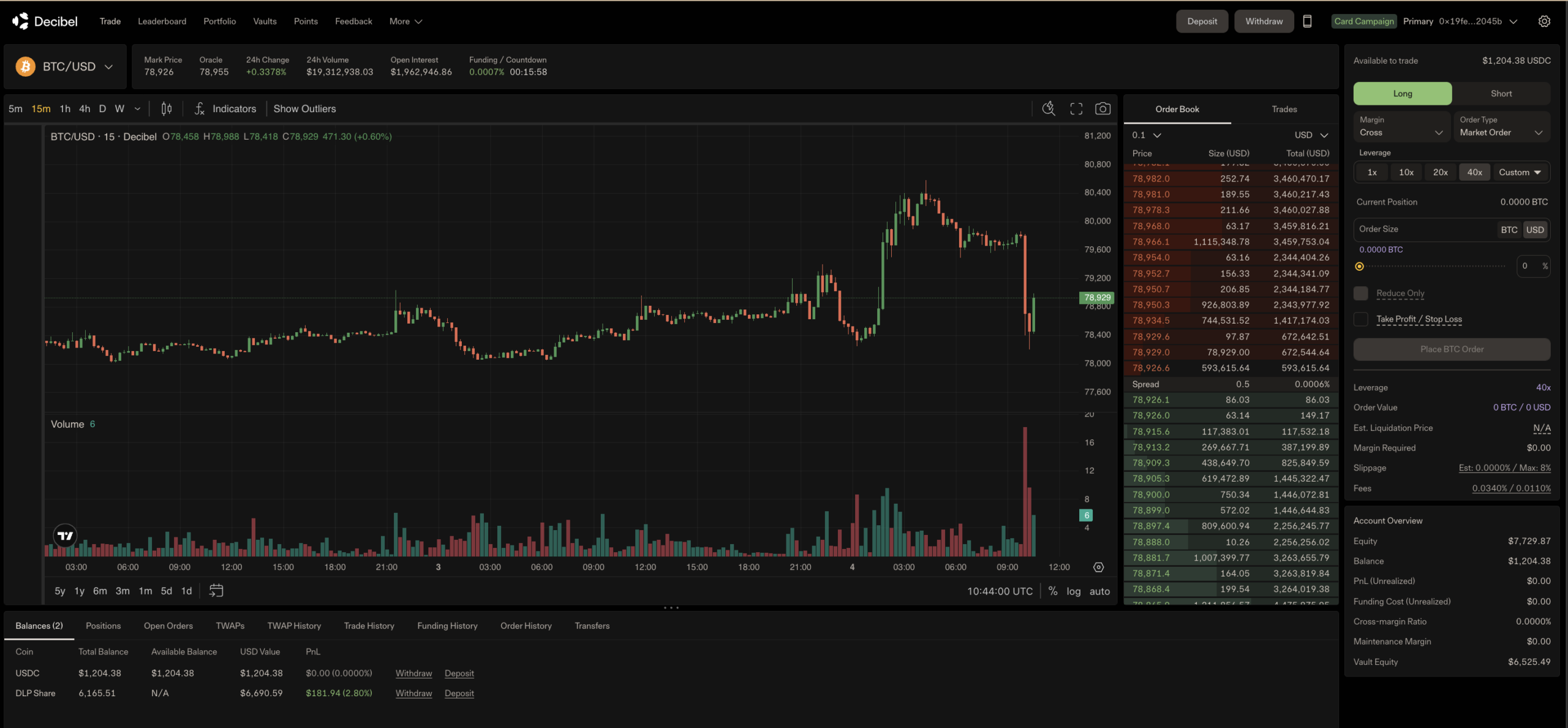
However, it is not a centralized exchange. Users interact through their wallets, retain custody, and trade through on-chain systems. Settlement, liquidations, and vault mechanics are visible on-chain.
Platform Walkthrough: Wallets, Portfolio, Leaderboard, and Feedback
Decibel is structured as a full trading workspace rather than only a perp terminal.
The Deposit / Withdraw module lets users move funds in and out of the platform. For Aptos-native activity, Decibel recommends Petra Wallet because it is built for the Aptos ecosystem and may offer a smoother deposit and withdrawal flow.
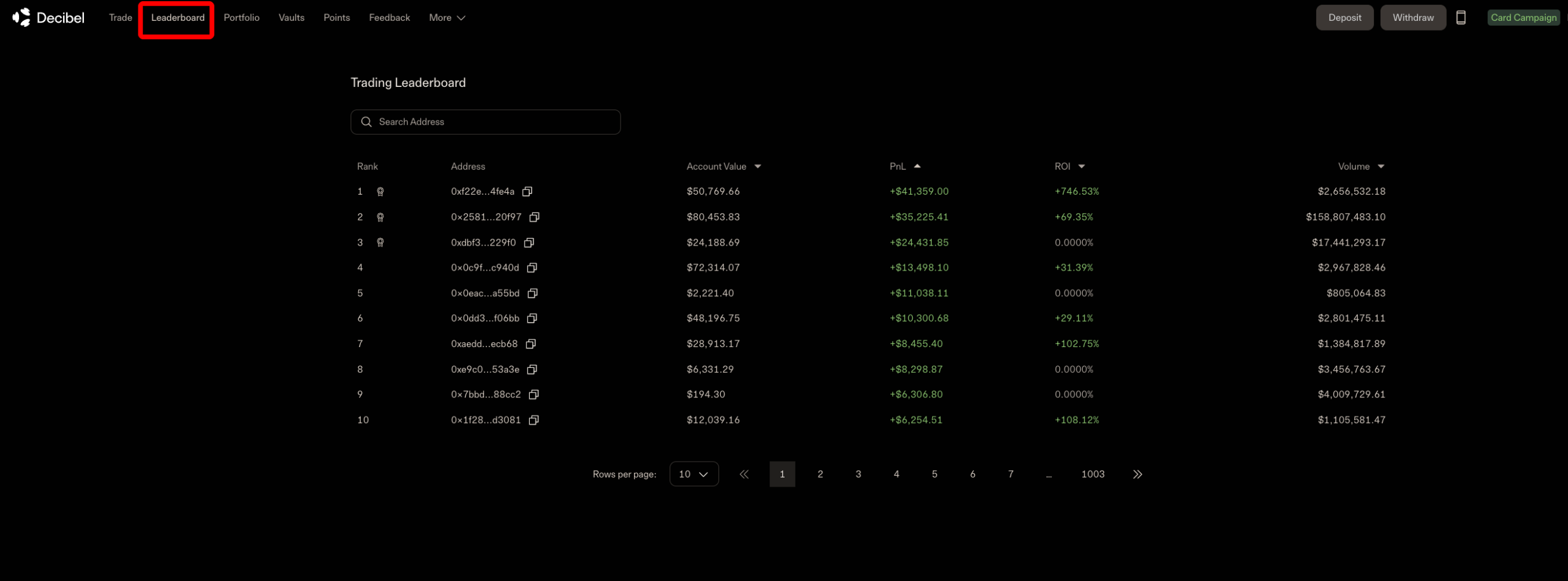
The Leaderboard ranks top accounts by PnL, ROI, Trading Volume, and Account Value. This adds a social and competitive layer to the trading experience.
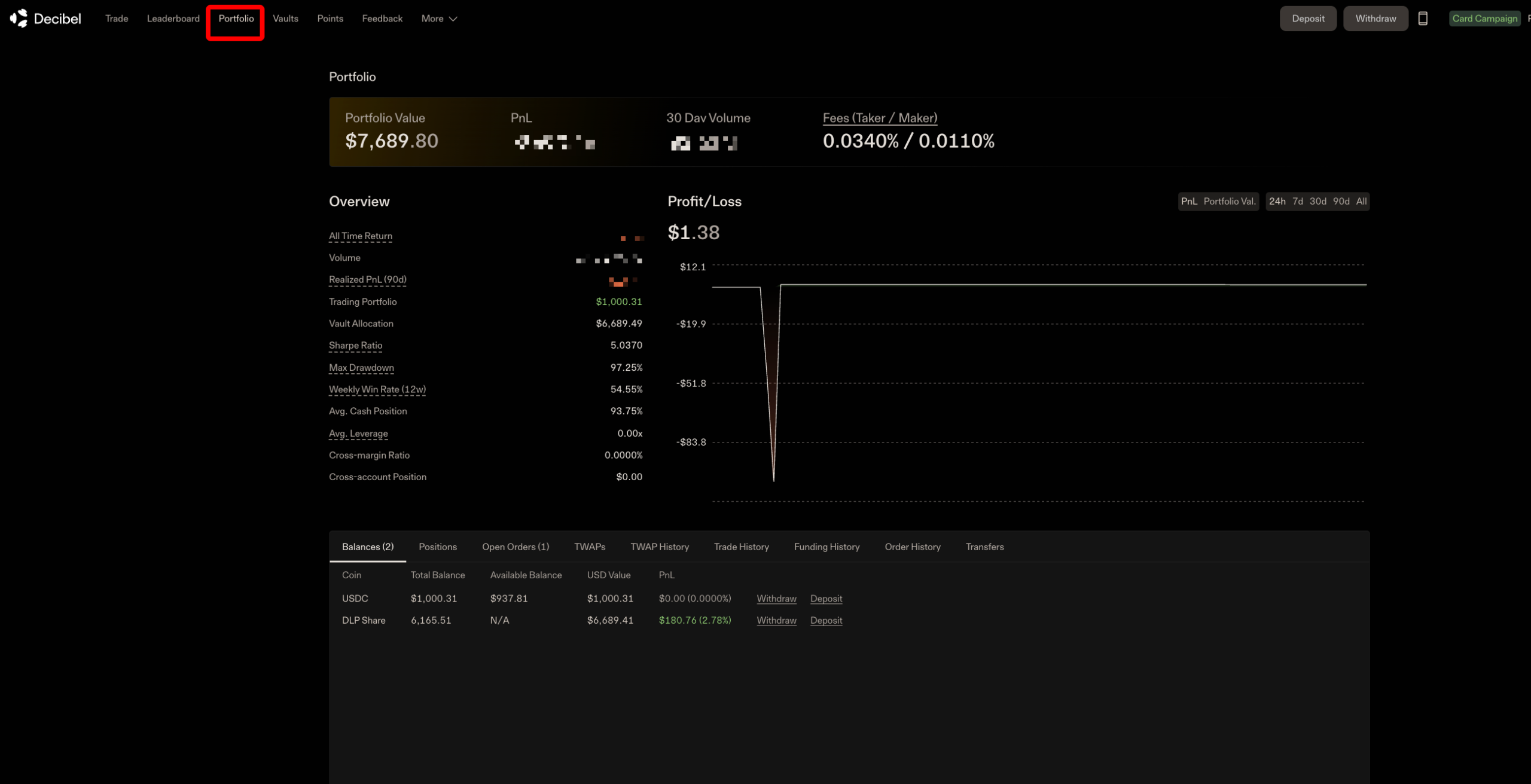
The Portfolio page gives users an overview of positions, balances, account value, and account performance.
Decibel also has a Feedback Hub, where users can report bugs, submit feedback, and suggest new features directly to the team. This is useful for an early-stage perp DEX because product iteration depends heavily on trader and market-maker feedback.
The “More” menu includes Accounts, API, Announcements, Rewards, Card Vault, Docs, Terms of Service, and Privacy Policy.
Market Structure and Liquidity
Decibel uses a central limit order book instead of relying only on AMM liquidity. This matters because active derivatives traders generally prefer order books for limit orders, tighter quoting, market making, and clearer price discovery.
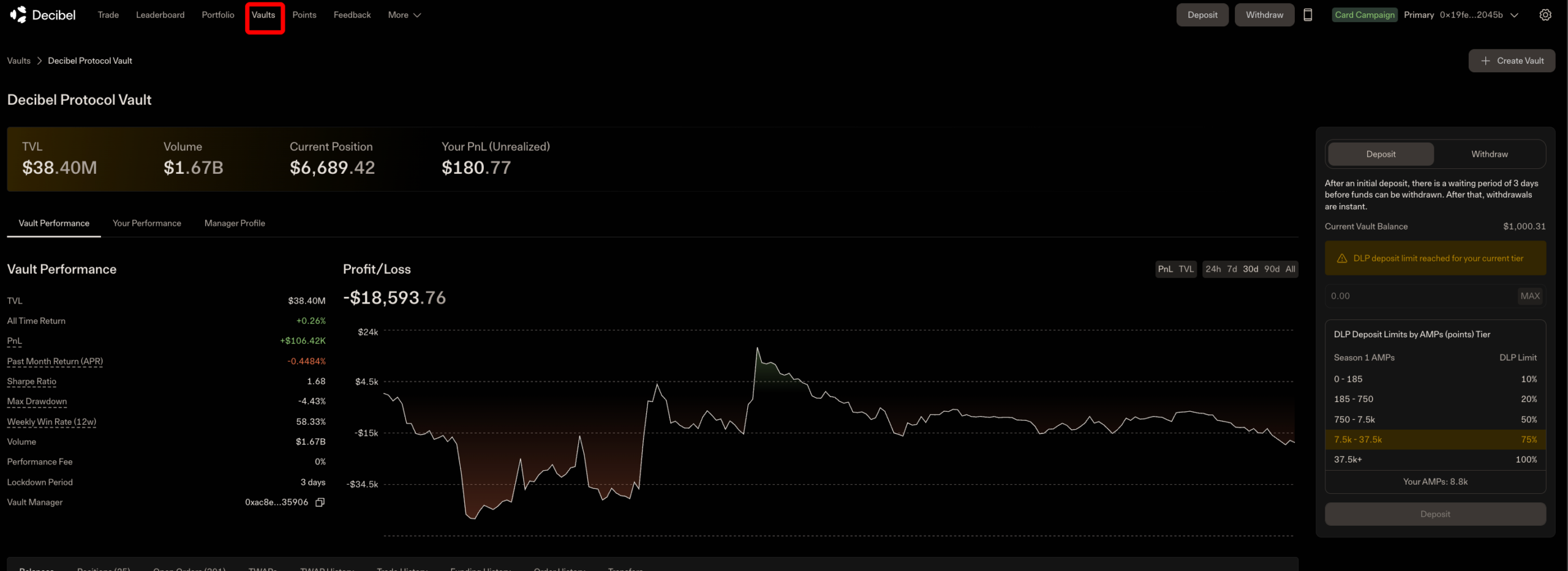
To bootstrap liquidity, Decibel uses the DLP Vault, its official liquidity vault. Users can deposit USDC into the vault to support market making, liquidity depth, and liquidation backstop mechanisms.
In return, depositors receive DLP Shares and may earn AMP Points rewards. This makes the DLP Vault relevant for both passive liquidity providers and users farming Decibel’s incentive program.
Decibel also supports user-managed vaults. A vault manager can trade pooled capital, while contributors receive fungible vault shares. Managers can charge performance fees between 0% and 10%, with crystallization intervals from 30 to 365 days.
Fees, Funding, and Incentives
Decibel uses a maker/taker fee model based on 30-day trading volume. At the base tier, official Decibel fee lists perps fees at 0.0340% taker and 0.0110% maker. At higher tiers, maker fees can fall to 0%.
Funding is continuous rather than periodic. According to Decibel’s funding, funding accrues around oracle updates instead of settling only every few hours. This helps keep perp prices aligned with spot and reduces funding-timestamp gaming.
Current incentives include:
| Program | What It Rewards |
|---|---|
| AMP Points Season 1 | Trading activity, liquidity, referrals, consistency |
| Referral Program | 10% of invitees’ Amps from a separate emission pool |
| Maker Rebate | Rebates for eligible high-maker-ratio accounts |
| Liquidation Rebate | Rebates for participating in liquidations |
| DLP Vault Rewards | DLP Shares and AMP Points |
| Card Vault | Weekly raffle tickets for physical graded card prizes |
Other derivatives protocols have experimented with different leverage and incentive mechanics, including designs such as InfinityPools, but Decibel’s current focus is simpler: order-book perps, vault liquidity, and activity-based points.
Airdrop and Points: How Decibel Amps Work
Decibel’s airdrop campaign is centered on Amps, its native points system. Season 0 covered pre-deposits, while Season 1 rewards mainnet activity.
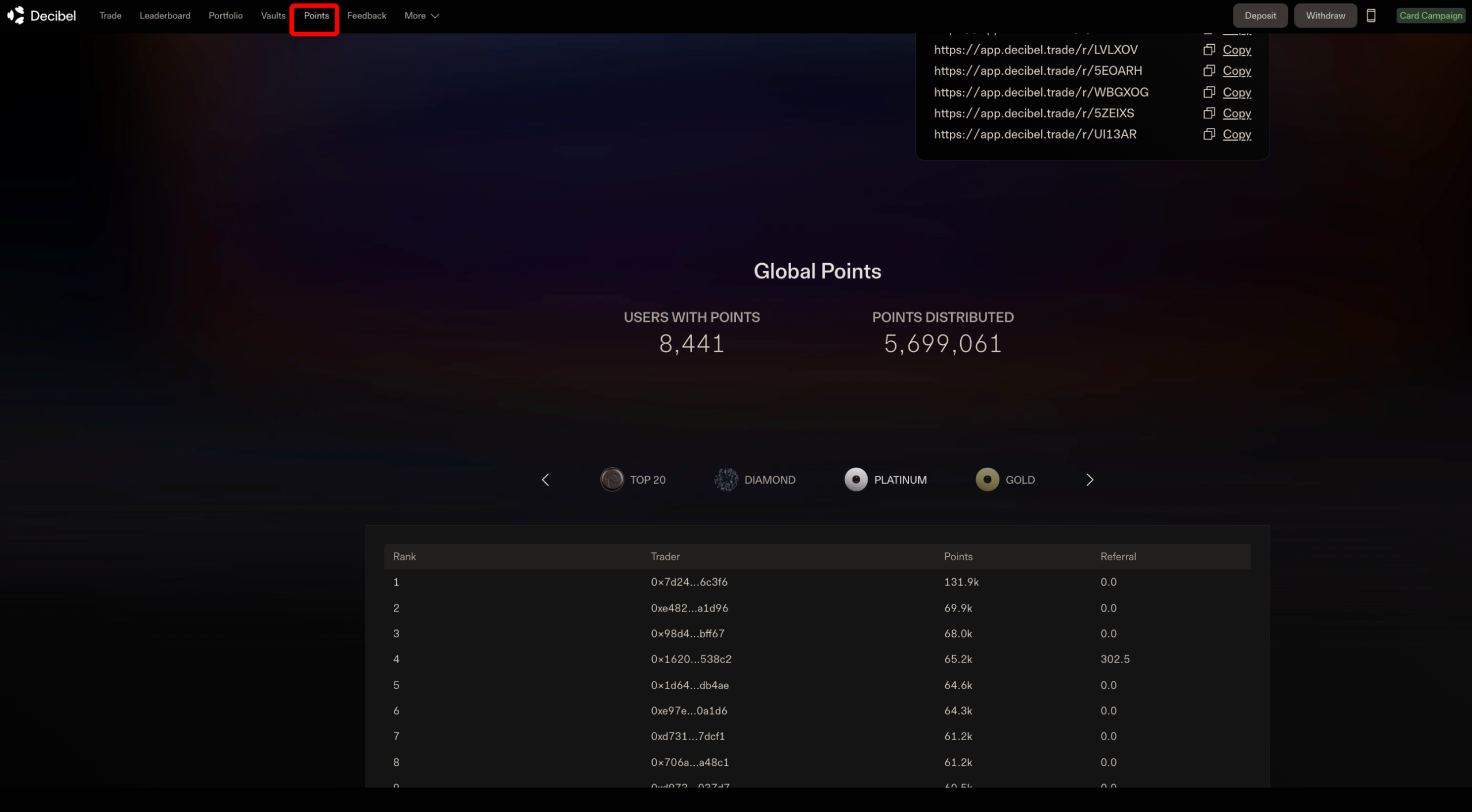
According to Decibel’s Amps documentation, Amps are a primary input for token distribution at TGE. This does not guarantee a fixed token allocation per point, but it does make Amps the key metric for users farming a potential Decibel airdrop.
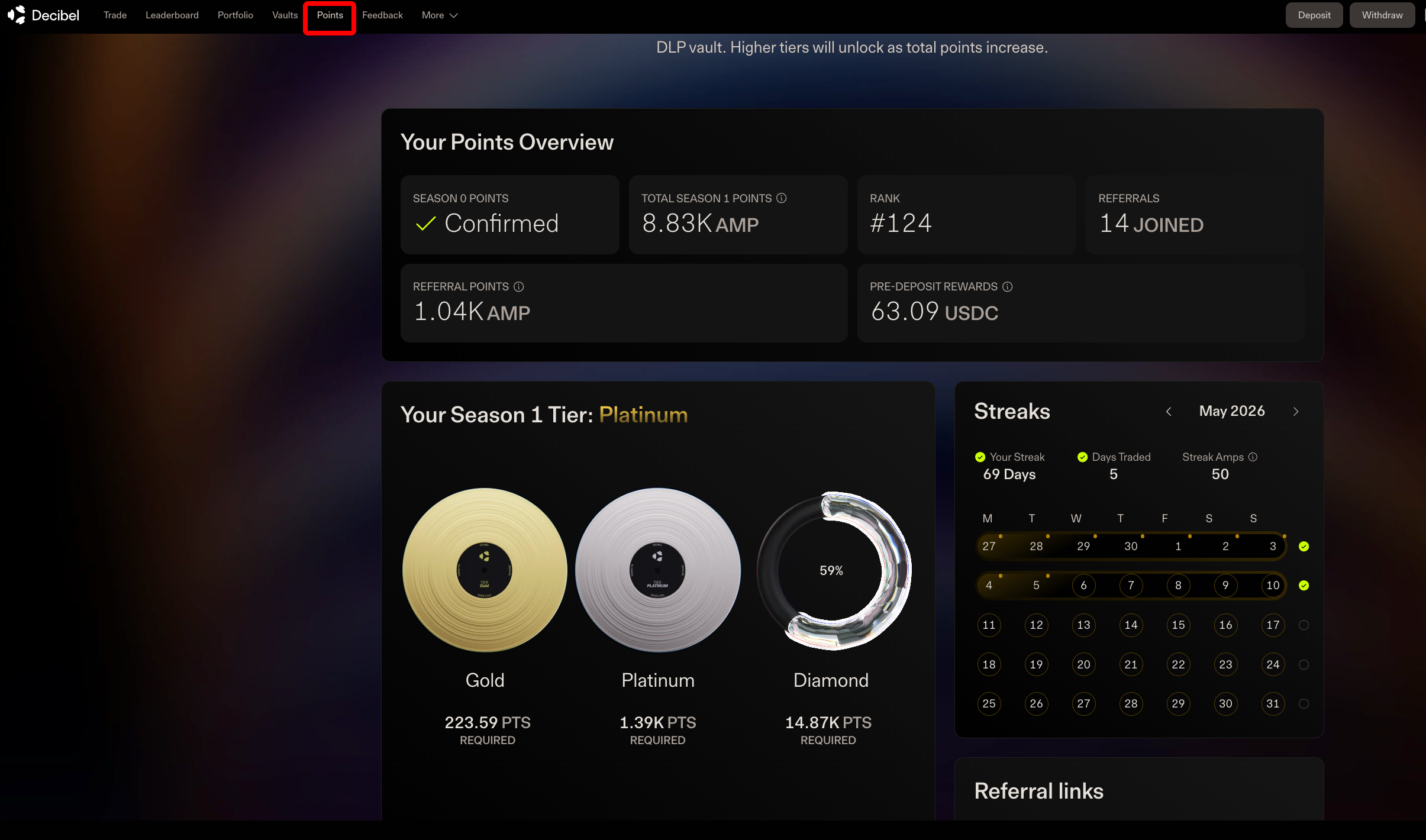
The Decibel Points page tracks Season 0 status, Season 1 Amps, rank, referrals, streaks, pre-deposit bonus, and tier progress. Screenshots show a gamified tier system including Gold, Platinum, and Diamond.
The exact scoring formula is not fully public. This is intentional, as Decibel wants to reduce Sybil farming and wash trading.
Card Vault: Decibel’s Trade-to-Win Campaign
Card Vault is Decibel’s 8-week campaign that rewards active traders with raffle tickets for real-world collectible prizes. Instead of only distributing points, Decibel gives traders a chance to win physical graded Pokémon card slabs.
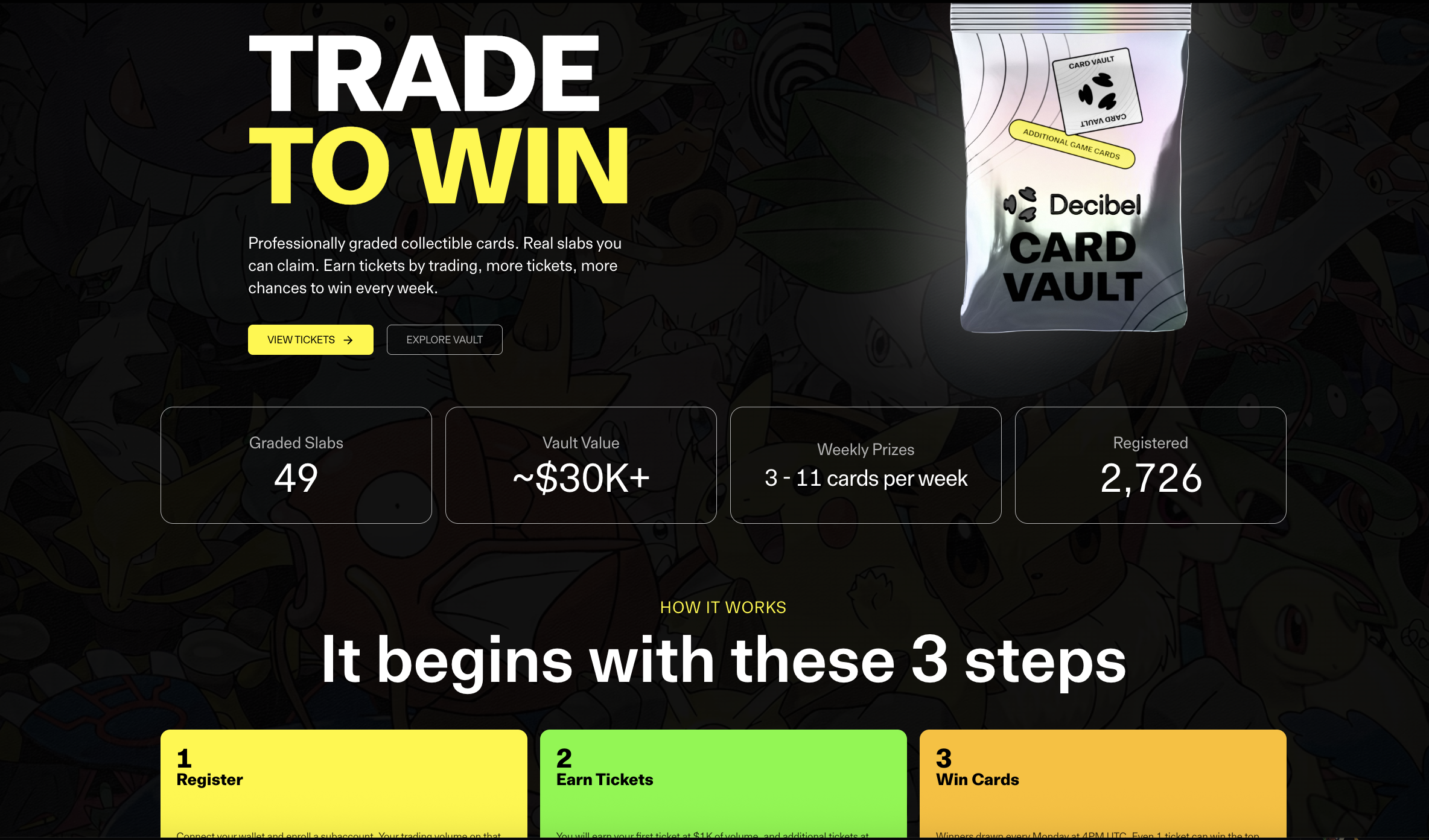
To participate, users need to register, deposit into the campaign vault, and generate qualifying trading volume. The campaign uses weekly raffle tickets, where higher volume gives users more entries. More details are available on Decibel’s Card Vault page and live campaigns page.
From the campaign screen and source document:
| Card Vault Detail | Data |
|---|---|
| Campaign length | 8 weeks |
| Reward type | Physical graded Pokémon card slabs |
| Graded slabs | 49 |
| Vault value | ~$30K+ |
| Weekly prizes | 3-11 cards per week |
| Registered users in source screenshot | 2,726 |
| Registered users in newer screenshot | 3,714 |
Card Vault is important because it gives users an immediate reward loop while they continue accumulating AMP Points for a potential future airdrop.
Security Model and Trade-Offs
Decibel’s security model is based on self-custody, Move smart contracts, on-chain settlement, oracle-based pricing, and transparent liquidations.
Liquidations happen when account equity falls below maintenance margin. Decibel uses market disposition and backstop liquidation mechanisms. In extreme conditions, auto-deleveraging can be used to protect protocol solvency.
The main risks include:
| Risk | Explanation |
|---|---|
| Smart contract risk | Bugs could affect funds, positions, or settlement |
| Oracle risk | Incorrect prices can affect funding, PnL, and liquidations |
| Liquidity risk | Thin order books may create slippage |
| Bridge risk | Cross-chain deposits rely on external bridge infrastructure |
| Leverage risk | High leverage can liquidate positions quickly |
| Incentive risk | Points farming may not translate into expected token value |
Strengths vs Limitations
| Strengths | Limitations |
|---|---|
| Fully on-chain order book | Still young compared with Hyperliquid or dYdX |
| CEX-like trading experience | Liquidity depth still needs to mature |
| Aptos speed and low latency | Dependent on Aptos performance |
| Cross-chain USDC deposits | Bridge and wallet UX can add friction |
| Continuous funding | Users must understand funding risk |
| Transparent liquidations | Liquidation risk remains high with leverage |
| AMP Points and Card Vault | Airdrop rewards are not guaranteed |
| Builder Codes, APIs, and vaults | Developer ecosystem is still early |
Who Decibel Is Best Suited For
Decibel is best suited for active DeFi traders, perp traders, market makers, bot developers, vault managers, and users farming potential airdrop exposure through real activity.
It may appeal to users who want a CEX-like interface but prefer self-custody and on-chain transparency. It is also attractive for Aptos ecosystem users who want native derivatives infrastructure.
Decibel is less suitable for complete beginners. Perpetual futures, leverage, funding, liquidation, points farming, and bridge-based deposits all require risk management.
The rise of wallet-native trading also matters here. Coinlive has covered MetaMask’s reported plans for Hyperliquid in-wallet trading, showing that perps are increasingly moving closer to the wallet layer. Decibel’s cross-wallet support fits that same direction.
What’s Next for Decibel?
Based on Decibel docs and public updates, the roadmap points toward a broader trading stack rather than only perpetual futures.
Expected or publicly discussed directions include:
| Upcoming Direction | Details |
|---|---|
| Multi-collateral | Support for APT, wrapped BTC, wrapped ETH, other stablecoins, and potentially RWAs as margin |
| Spot trading | Listed as a future product direction |
| More perp markets | Expansion beyond initial major crypto pairs |
| Real-world assets | Longer-term expansion into RWAs, equity indices, FX, and synthetic assets |
| Vault ecosystem | More user-managed vaults and strategy managers |
| AI-agent trading | MCP and CLI tooling for programmatic and agent-based trading |
| Builder ecosystem | More apps using Builder Codes, bots, vaults, and trading interfaces |
| Rewards page | App menu shows Rewards as a coming dedicated rewards hub |
This roadmap puts Decibel closer to a full trading infrastructure layer than a single-product perp DEX. That direction is also consistent with the wider Hyperliquid ecosystem, where projects such as Based Streams on Hyperliquid show how trading infrastructure can expand into broader on-chain applications.
Conclusion
Decibel is an ambitious attempt to build a fully on-chain derivatives exchange with the speed and workflow of a centralized exchange. Its strongest technical feature is its Aptos-native on-chain CLOB, which makes matching, settlement, margin, and liquidations more transparent than many hybrid DEX designs.
The data shows meaningful early traction: large testnet activity, tens of millions in TVL, an active points campaign, DLP liquidity incentives, and Card Vault gamification. But Decibel is still early. Its long-term success depends on whether it can keep liquidity after incentives, attract professional market makers, and compete with larger venues like Hyperliquid, dYdX, GMX, Drift, and Jupiter Perps.
Coinlive has also covered how centralized exchanges list derivative products such as Hyperliquid perpetual futures on Coinbase, highlighting a key trend: perp markets are no longer only a CEX product. Decibel is part of this shift toward transparent, on-chain derivatives infrastructure.
For now, Decibel is one of the more interesting perp DEXs to watch, especially for users interested in Aptos, on-chain order books, and potential airdrop opportunities through AMP Points.
FAQs
Does Decibel have an airdrop?
Decibel has not published a fixed token allocation formula, but its docs state that Amps are a primary input for token distribution at TGE.
How do users farm Decibel Amps?
Users can earn Amps through trading, referrals, vault liquidity, streaks, and broader platform activity.
What is Card Vault?
Card Vault is an 8-week campaign where eligible traders earn weekly raffle tickets for physical graded Pokémon card slabs.
What makes Decibel different?
Its main difference is the fully on-chain CLOB. Orders, matching, settlement, liquidations, and risk logic are verifiable on Aptos.
What is DLP Vault?
DLP Vault is Decibel’s official liquidity vault. Users deposit USDC to support liquidity and liquidation backstop functions, receiving DLP Shares and potential AMP Points rewards.

Author
Akita Inu
Akita Inu covers fast-moving crypto market updates, exchange news, and token ecosystem developments for CoinLive, with a focus on concise source-led reporting.