| Disclosure: This content is promotional in nature and provided by a third-party sponsor. It does not form part of the site’s editorial output or professional financial advice. |
Ethereum has long been the main platform for EVM-based activity, handling around 15 to 30 transactions per second on its base layer. During times of high use, gas fees often rise above $20, making simple actions costly for many users. The network operates with validator participation spread across more than 900,000 nodes, and since launch, it has settled trillions of dollars in on-chain value. These facts underline Ethereum’s strong position as the core EVM network, but they also show clear limits at the base layer.
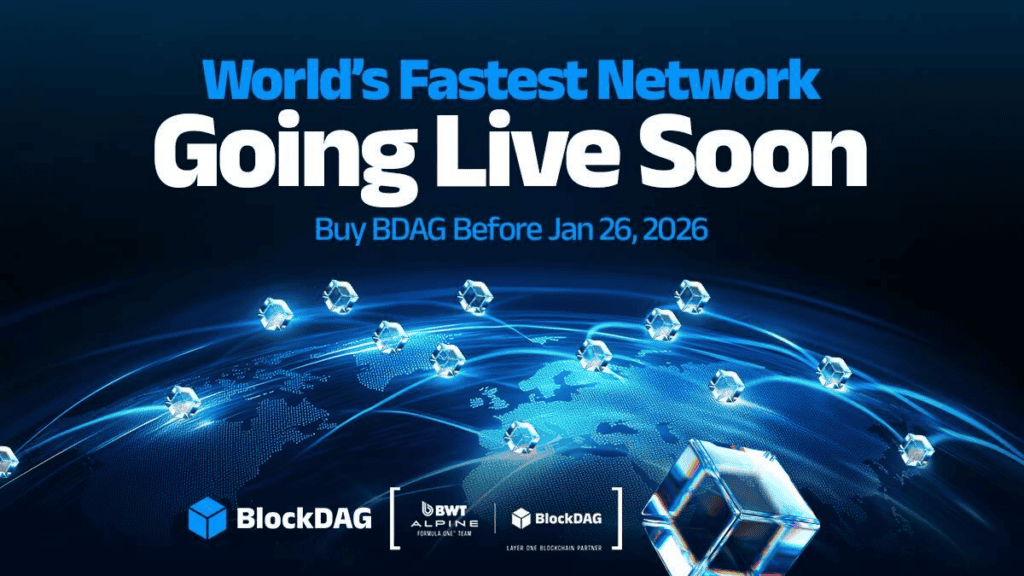
As demand continues to grow, these limits have shaped how EVM activity is handled today. Most usage no longer stays on Ethereum’s main chain. Instead, it moves to secondary layers to manage volume and cost. Against this setting, BlockDAG (BDAG) enters the discussion by presenting a different base-layer design that claims to process up to 1,400 transactions per second. This difference brings attention to how EVM performance can be delivered directly at Layer 1 rather than pushed outward.
Ethereum’s Base Layer EVM Constraints
Within the EVM space, Ethereum remains the default choice for developers. It supports thousands of decentralized apps, stablecoins, and DeFi systems. Its execution rules are widely trusted, and its tools are supported by the largest developer base in the sector. Even so, upgrades such as the Merge have not led to major increases in base-layer transaction speed.
Because of this, Ethereum depends heavily on Layer-2 systems like rollups to handle more activity. These layers raise capacity but also divide liquidity and add technical steps. Moving value across layers introduces delays, extra risk, and added user effort. Final confirmation still depends on the settlement back to the main chain. For builders working on fast-moving or data-heavy use cases, this setup means planning around congestion, changing fees, and slower confirmation times.
BlockDAG’s Layer-1 EVM Throughput Structure
BlockDAG approaches the same EVM environment with a different structure at its core. Instead of relying on a single straight chain of blocks, it uses a Directed Acyclic Graph model. This allows multiple blocks to be processed at the same time rather than one after another. Through this parallel design, BlockDAG reports support for up to 1,400 transactions per second at Layer 1 while keeping EVM compatibility.

For developers, this setup allows smart contracts to run using familiar tools without needing rollups or added layers. Transaction flow is handled through graph-based agreement rules, which help reduce slowdowns during busy periods. Rather than shifting activity away from the base chain, BlockDAG builds higher capacity directly into its main structure. This makes scaling part of the protocol itself instead of an external requirement.
EVM Use Without Heavy Layer-2 Reliance
Ethereum’s long-term scaling plan separates execution, data handling, and settlement across different layers. While this design supports security goals, it also creates added complexity. Apps must manage bridges, split liquidity, and different timing rules across layers. These factors increase planning effort for both builders and users.
BlockDAG takes a more consolidated path by keeping execution at Layer 1 while still supporting EVM wallets and workflows. With more room for transactions at the base layer, fees become less sensitive to sudden spikes in use. This can support steady performance for apps that need quick responses, such as games, live financial tools, and automated business systems. In this way, BlockDAG offers another option for EVM workloads where base-layer speed matters most.


Network Economics and Presale Momentum
Ethereum’s fee structure is closely tied to its limited block space. High demand leads users to compete through higher fees, which can slow activity during peak times. BlockDAG addresses this issue by expanding available throughput, increasing block space supply instead of restricting access through cost pressure.
Interest in this model is visible in BlockDAG’s ongoing presale. More than $443 million has already been raised, with around 3.1 billion coins still remaining. The current presale batch is Batch 35, offering a special price of $0.003 per coin. The presale is set to end on January 26, marking the final stage before broader network rollout. If the future price reaches $0.05, this reflects a 16.67x difference from today’s level, equal to a potential 1,566% upside.
An Evolution Within the EVM Space
This comparison is not about removing Ethereum from its role. Ethereum continues to act as a core settlement layer with deep liquidity and strong security focus. Its cautious approach favors stability over raw speed. BlockDAG, on the other hand, focuses on improving execution speed within the same EVM rules by changing how blocks are processed.
This relationship reflects earlier shifts in blockchain design, where newer systems added options rather than replacing older ones. By staying compatible with existing tools, BlockDAG allows developers to apply known skills while working with a faster base layer. This creates a wider EVM space where different networks serve different needs based on design choices.
Final Say
Ethereum established the standard for smart contract execution, but its base-layer limits have moved much of its activity to added layers. BlockDAG addresses the same issue by building higher transaction capacity directly into Layer 1 while keeping EVM support intact.
With a stated 1,400 TPS design, crypto presale funding above $443 million, and a $0.003 special price ahead of the January 26 presale ending, BlockDAG presents a speed-focused option within the EVM ecosystem. As demand for EVM-based apps continues to rise, this contrast highlights how base-layer performance is becoming a key design choice rather than an afterthought.
Presale: https://purchase.blockdag.network
Website: https://blockdag.network
Telegram: https://t.me/blockDAGnetworkOfficial
Discord: https://discord.gg/Q7BxghMVyu
| Disclaimer: The text above is an advertorial article that is not part of coinlive.me editorial content. |