


Hyperliquid Review 2026: Perpetual Trading, HLP, and Risks
Hyperliquid Review 2026 covering HyperCore order-book trading, deposits and withdrawals, margin, liquidation, HLP vault exposure, validators and the JELLY incid...

Hyperliquid is one of the stronger on-chain perpetual venues for experienced traders who want a fast order book, wallet-based access and a dedicated trading chain instead of a conventional exchange account. Its appeal is execution and composability; its trade-off is that deposits, leverage, liquidations, HLP and emergency market actions all require more active risk management.
This review finds that Hyperliquid can suit a trader who already understands wallet signing, collateral routes and perpetual risk. It is less suitable for someone seeking simple account recovery, fiat onboarding or passive yield: its HLP vault, validator model and the March 2025 JELLY intervention add dependencies that a standard exchange user may not expect.

Key takeaways
- HyperCore gives active traders a wallet-signed, order-book environment, but the trade only works as expected when the collateral route, account state and market parameters are understood.
- Leverage is the main operational risk: market-specific tiers, maintenance margin, funding and the order-book or backstop route determine the result after a position becomes unhealthy.
- HLP is market-making exposure rather than idle USDC. The March 2025 JELLY settlement shows why a vault depositor and a direct trader need different risk limits.
Hyperliquid in practical terms
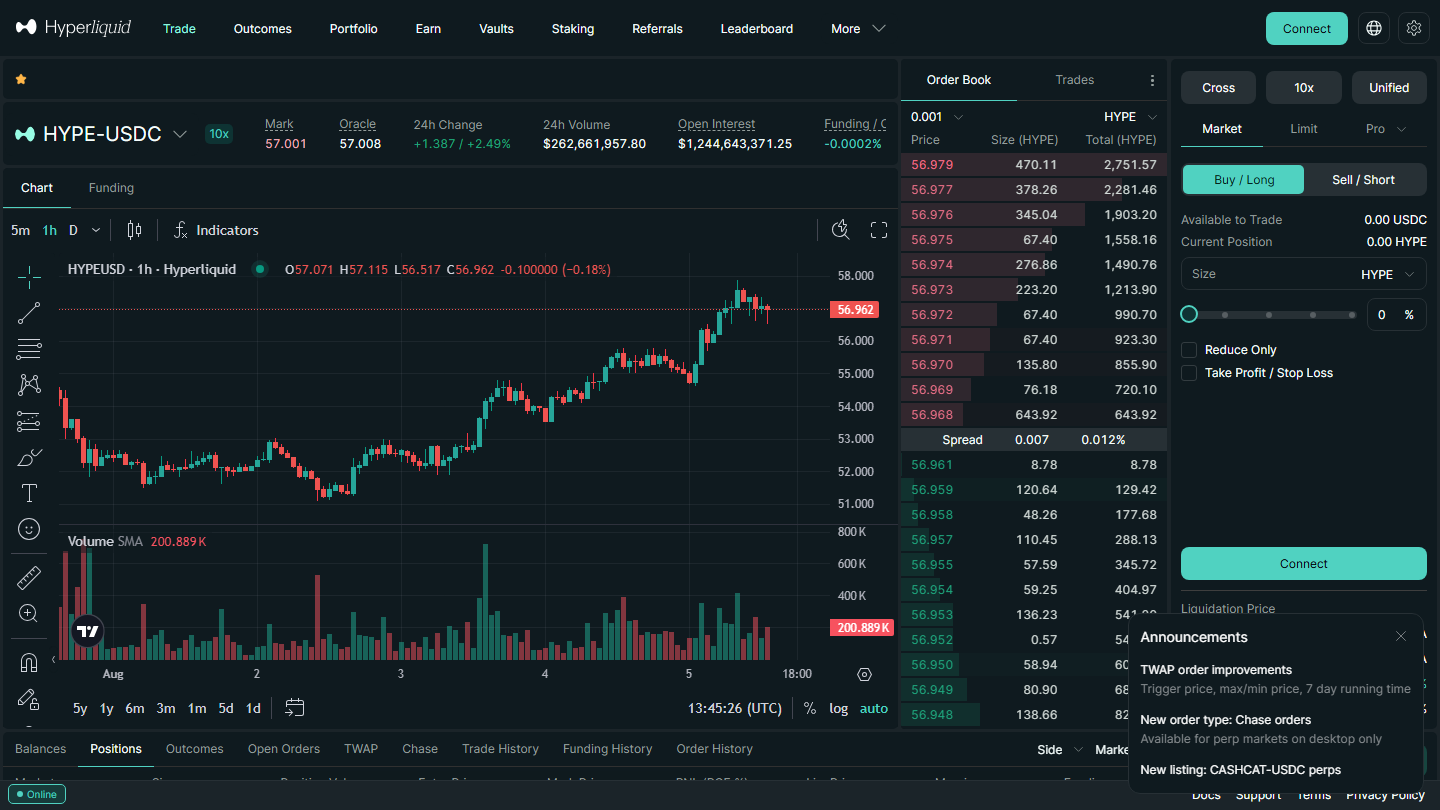
Hyperliquid combines a purpose-built Layer 1 with a visible order book for perpetual trading. The design aims to offer the speed and market controls familiar to centralized-exchange users while leaving signing authority with a connected wallet. That combination is why it is compelling for crypto-native traders who want to place, amend and close positions without first creating a custodial account.
The product is not a single-risk system. A complete review has to separate wallet authorization, HyperCore execution, bridge movement, margin, validator operation, HLP and governance. A visible order book improves transparency, but it does not make every failure path or recovery path identical.
- Trading model: orders are signed from a wallet and managed through a dedicated perpetual-trading environment.
- Collateral model: a displayed trading balance only becomes usable after the intended asset and route are credited to the Hyperliquid account.
- Risk model: the trader controls size and leverage, while the venue’s margin and liquidation rules govern account health.
- Exit model: a withdrawal request still depends on the selected route, validator processing and the destination network.
The Hyper Foundation site provides network and ecosystem context, but a public network description is not a substitute for a user-level custody checklist. Before funding, confirm the wallet address, the chain route, the collateral asset and the withdrawal destination. A self-custodial label does not protect a user who signs the wrong transaction or sends funds through an unverified route.
The perpetual DEX explainer gives useful general context for wallet-based perps, collateral and liquidation. Hyperliquid adds a specialized trading chain, so the user must also understand how funds move from the source network into the trading environment and back out again.
Funding, custody, and withdrawals
Funding a Hyperliquid account is not the same as holding funds in the source wallet. The route may involve a bridge, a supported collateral asset, validator signatures and a destination account. A successful deposit confirms that one route worked. It does not prove that every withdrawal route has the same timing, capacity or trust assumptions.
- Source wallet: a wrong chain, token or destination address can make a transfer unrecoverable.
- Bridge or deposit route: contract, signer and message-delivery assumptions exist before collateral reaches the trading balance.
- Credited balance: compare the amount sent with the amount credited and resolve any account mismatch before trading.
- Withdrawal and receipt: the destination chain, token representation and validator processing matter as much as the button used to request the exit.
Funding and withdrawals belong in the product verdict rather than as an afterthought. A venue is only operationally useful when a trader can exit with the intended asset, not merely open a position quickly.
An archived Hyperliquid withdrawal-access report collected September 16, 2026 describes a user whose wallet was flagged after a deposit and who said the interface would not let them withdraw. The account is an attributed report, not proof that the platform confiscates funds or that the same route applies today; replies also described alternate exit routes. Its practical value is narrower: test a small deposit and withdrawal with the exact wallet, collateral asset and permitted region before treating a displayed balance as immediately deployable capital.
Do not treat a fast trading interface as proof of fast withdrawals. A trading action and a bridge settlement can have different actors, different finality and different failure handling. A treasury or large trader should test the complete route with an amount that is operationally meaningful before relying on it for regular settlement.
Order-book execution on HyperCore
Hyperliquid’s trading experience is built around a custom Layer 1 and an on-chain order book. The platform aims to make order placement, matching and settlement feel closer to a centralized exchange while keeping trading state observable on the network. That specialization is a major reason active traders use it.
- Wallet signing: verify the account approved the precise order, leverage and collateral action shown in the wallet prompt.
- Order book: confirm that an order was accepted, matched or cancelled as intended rather than assuming a submitted order is final.
- Margin and liquidation: read the live equity, mark price, maintenance requirement and forced-close rule that apply to the account.
- Chain consensus: the finalized trade and balance depend on the validator state of Hyperliquid’s chain.
The advantage is visibility. A trader can inspect order and account activity more directly than on a custodial exchange where the internal matching ledger is not publicly settled in the same way. The disadvantage is that transparency of output does not prove that every component has the same decentralization or audit boundary.
This differs from a pool-based venue. The GMX market context helps illustrate the contrast: pool capacity, oracle pricing and liquidity-provider exposure are central there, while Hyperliquid puts more attention on order-book state, chain consensus and account-level margin.
Margin, leverage, and liquidation
Hyperliquid’s security profile also depends on how margin is calculated. The trader can lose collateral through an adverse move, funding, fees or forced liquidation even when the wallet key remains under personal control. Non-custody protects against one category of exchange failure; it does not remove leveraged-trading loss.
- Position notional and initial margin: these set the economic size of the exposure opened with the available collateral.
- Maintenance margin and mark price: these decide whether the account remains healthy; they matter more than a chart’s last-traded price.
- Funding: recurring debits or credits change account equity while the position stays open.
- Liquidation route: this determines whether an unhealthy position is reduced on the order book or passed to the backstop process.
Cross margin can let positions share account equity, but it can also make one position affect the risk buffer of another. Isolated margin defines a narrower collateral boundary, yet spare wallet funds may not protect the isolated position automatically. The trader must know which mode is active before signing.
Margin tiers and forced-close mechanics
Hyperliquid’s published margin-tier rules make the liquidation boundary more specific than a generic leverage warning. The figures below are program parameters, not an offer of usable leverage or a substitute for the live market ticket.
| Risk field | Published parameter | Security implication |
|---|---|---|
| BTC position up to $150 million | 40x maximum leverage | The implied maintenance rate at that tier is 1.25%, leaving little room for an adverse mark move. |
| ETH position up to $100 million | 25x maximum leverage | The corresponding maintenance rate is 2.0%; a trade can be liquidatable before its last-trade chart reaches the expected stop. |
| SOL position up to $70 million | 20x maximum leverage | The corresponding maintenance rate is 2.5%, with a lower maximum tier above that notional. |
| Liquidatable position above $100,000 | 20% partial market liquidation | A forced close can begin as a partial reduction rather than a single all-or-nothing event. |
| Post-partial-liquidation window | 30 seconds | During this cooldown, subsequent liquidation orders can target the full remaining position. |
| Failed order-book liquidation | Backstop below two-thirds of maintenance margin | The liquidator vault can become the next stage when normal market orders do not restore health. |
The liquidation rules state that account equity below maintenance margin initiates the process. The first step is a market order against the book; the liquidator vault is not the normal first destination. That sequence matters because the displayed liquidation price is a risk trigger, not a guaranteed exit price or a promise of how much collateral will remain.
The CoinLive funding interval coverage is useful for understanding how recurring payments affect a position. Hyperliquid’s exact funding and margin records still belong to the current market and account. A position that is safe at entry can become closer to liquidation after funding debits and adverse PnL accumulate.
Liquidation should be reviewed through mark price and account health, not only the last trade on a chart. If the position is forcibly closed, save the mark price, maintenance requirement, funding line, order state and execution record before the interface updates. This is how a trader distinguishes a normal risk-engine action from an unexplained accounting mismatch.
HLP vault exposure and market-making risk
Hyperliquid’s HLP and related vault structures provide a way to participate in liquidity and market-making activity without placing every order manually. That does not make the exposure equivalent to a cash balance. A vault can be affected by trader PnL, liquidation events, strategy parameters, market imbalance and protocol decisions.
- Direct perp trader: the main exposures are margin, order-book execution and the liquidation engine.
- Vault depositor: returns and losses depend on strategy decisions, vault accounting and trader outcomes.
- HLP liquidity provider: market making, liquidation events and protocol rules can affect the deposited capital.
- HYPE staker: this is exposure to network and governance economics, not a substitute for a trading-risk assessment.
The review should state which exposure it is describing. A trader’s self-custody does not mean a vault depositor has no counterparty or strategy risk. A vault can be transparent and still lose value. A visible performance history is evidence of past operation, not a guarantee of future yield.
Validators and intervention risk
Hyperliquid’s custom chain needs validators to order, finalize and maintain the trading state. That can improve performance because the network is tuned for a focused workload, but it also makes validator participation central to the security discussion. The relevant question is not whether validators exist. It is how much control is concentrated, how stake determines influence and how emergency decisions are made.
- Validator set and stake: these determine the practical operator group and how concentrated influence can become.
- Emergency market authority: the ability to halt or alter a market defines the limits of ordinary trading execution.
- Withdrawal finality: validator activity connects network control to the user’s ability to exit with the intended asset.
- Governance record: clear public records of interventions are the basis for holding operators accountable after an incident.
Bitwise’s public Hyperliquid research discusses the platform’s market structure and validator dependencies. The useful takeaway is not a single decentralization score. It is that a fast appchain asks users to evaluate consensus, trading and custody as one connected system.
This is the central security trade-off. A user may prefer Hyperliquid because the order book and account state are more visible than on a custodial exchange. The same user may reasonably reject it if validator concentration or emergency governance falls outside their risk tolerance.
The Avantis and Aster venue comparison provides a useful contrast because different perp architectures place security responsibility in different layers. Hyperliquid concentrates more of the execution and settlement path in its own chain, so chain and validator diligence cannot be skipped.
The JELLY incident and governance response
The March 2025 JELLY event is important because it tested what happens when a market moves in a way that threatens the normal risk framework. A 2026 securities filing describing the event reports that coordinated trading exploited the liquidation and margin parameters, leaving approximately $13.5 million of losses in HLP vaults. The filing describes a mechanism outcome rather than unauthorized access to the protocol.
- Market: JELLY perpetual in March 2025 showed that low-liquidity markets create a different tail risk from BTC or ETH.
- HLP-vault impact: the filing reports approximately $13.5 million in losses, tying vault capital to liquidation-engine behavior and market-manipulation risk.
- Validator action: the market was delisted and open positions were settled, showing that a normal trading path can be overridden during a system-level intervention.
- Settlement reference: the cited $0.0095 settlement, rather than the roughly $0.50 listed price, shows how an intervention can alter the resolution of an open position.
That changes the security question from routine order execution to the authority that decides when ordinary execution is no longer allowed. A trader needs to understand the possibility of market restrictions, forced settlement, account treatment, and governance communication before using a venue with this intervention model.
The incident also shows why security reviews should not rely on wallet custody alone. The user’s key may remain self-controlled while the market, settlement rule or withdrawal route is governed by a network-level decision. Custody and execution sovereignty are related, but they are not identical.
Hyperliquid user fit and first-trade checks
Hyperliquid is a better fit for an active, self-directed perp trader than for a user seeking a simplified exchange account or a passive vault product. The first trade should be treated as an operational test, with enough evidence to confirm the route, position controls and exit path before capital is scaled.
- Confirm the official front end and wallet route.
- Verify the source and destination network for the intended collateral.
- Make a small deposit and confirm the credited trading balance.
- Review the withdrawal path, finality and destination asset.
- Check whether the position uses cross or isolated margin.
- Read the mark-price, funding and liquidation fields before opening.
- Test reduce-only, stop and cancel behavior with a small position.
- Keep a record of order, account and withdrawal identifiers.
- Separate direct trading from HLP or vault exposure.
- Decide whether validator intervention is acceptable for the intended capital.
The CoinLive position-management guide adds practical exit context. A security review is stronger when it tests the close path before the user commits meaningful capital, not when it only describes the opening interface.
The Vertex venue overview is another useful comparison point for readers reviewing account-based derivatives systems. The relevant security question is always where custody, matching, margin and withdrawal responsibility sit in the specific venue.
Hyperliquid review: strengths and trade-offs
Pros
- Wallet-based access gives users more direct custody control than a traditional custodial exchange.
- On-chain order-book and account activity improve execution transparency.
- A dedicated trading chain can make order placement and position management feel responsive.
- Margin, liquidation and market activity are part of a specialized trading environment.
- Active traders can inspect more of the trading path than they can on a private exchange ledger.
Cons
- Validator concentration remains a material decentralization and intervention risk.
- Bridge and withdrawal security are separate from the trading interface.
- Leverage can rapidly consume collateral through PnL, funding and liquidation.
- HLP and vault exposure is strategy and market risk, not passive cash custody.
- The platform is difficult for beginners who need fiat rails, account recovery or simplified risk controls.
Conclusion
Hyperliquid is a credible choice for experienced traders who value a fast on-chain order book, wallet-based authorization and direct visibility into account activity. Its real edge is the trading experience, not a blanket claim of safety or passive yield.
The trade-offs are material: funding and withdrawal routes, leverage, HLP market-making exposure, validator concentration and emergency intervention all affect the result. Traders who can test those paths and actively manage risk may find the venue compelling; beginners and capital that needs simple recovery or predictable custody controls should use a more conservative setup.
FAQs
Is Hyperliquid non-custodial?
Hyperliquid is commonly used through wallet-based access, which gives users direct control over signing authority. Bridge, validator, account and liquidation rules still create separate dependencies.
Does on-chain order-book activity make Hyperliquid fully decentralized?
No. Visible execution improves transparency, but full decentralization also depends on validator participation, governance, emergency controls and the degree of network concentration.
Is HLP the same as holding USDC in a wallet?
No. HLP and other vault exposure depends on market-making, liquidation, strategy and trader outcomes. It can lose value even when the underlying trading activity is transparent.
Is Hyperliquid suitable for beginners?
Usually not. The product assumes that users understand wallet custody, bridge routes, order books, margin, funding and liquidation before committing capital.
Disclaimer: This article is for informational purposes only and does not constitute financial or investment advice. Cryptocurrency and digital asset markets carry significant risk. Always do your own research before making decisions.
More From Review

Synthetix Perps Review 2026: Mainnet CLOB, Multi-Collateral, and Liquidation Risk
A practical Synthetix Perps review covering its Ethereum Mainnet CLOB, ETH and USDT margin, fees, funding, liquidation route, SLP vault, and trader risk.

Lighter Perpetuals Review 2026: Order Book, Zero-Fee Claims, and Market Depth
A practical Lighter Perpetuals review covering order-book execution, zero-fee trading, funding, margin, liquidation, and Ethereum exit
