


Synthetix Perps Review 2026: Mainnet CLOB, Multi-Collateral, and Liquidation Risk
A practical Synthetix Perps review covering its Ethereum Mainnet CLOB, ETH and USDT margin, fees, funding, liquidation route, SLP vault, and trader risk.

Synthetix Perps is a credible venue for an experienced Ethereum trader who wants onchain custody but prefers a central-limit-order-book trading experience over an AMM quote. The live product matches orders offchain, settles collateral on Ethereum Mainnet, and currently accepts ETH and USDT as margin. That combination can reduce bridge friction and keep collateral on mainnet, but it also means a trader must manage a cross-margin account rather than judge one position in isolation.
The direct verdict is conditional. Synthetix fits a trader who can monitor account value, maintenance margin, funding and collateral haircuts across every open position. It is not the easy choice for someone who wants an isolated-margin account, a fixed liquidation number or a passive place to leave ETH while using leverage.

Key takeaways
- Synthetix Perps now operates as an Ethereum Mainnet hybrid CLOB: orders are matched offchain while collateral and settlement remain onchain.
- ETH and USDT margin improve capital flexibility, but non-USDT collateral can change account health through price moves and haircuts.
- The liquidation boundary belongs to the whole sub-account, including funding, fees, other PnL and collateral value, rather than to one trade alone.
The current product is an Ethereum Mainnet hybrid CLOB
Synthetix’s current perpetual futures product is not the old L2 AMM system commonly described in legacy explainers. The platform now combines offchain order matching with Ethereum Mainnet custody and settlement. A trader gets an order book, market and limit orders, plus stop-loss, take-profit, scaled orders and TWAPs, while the deposited collateral remains on Ethereum.
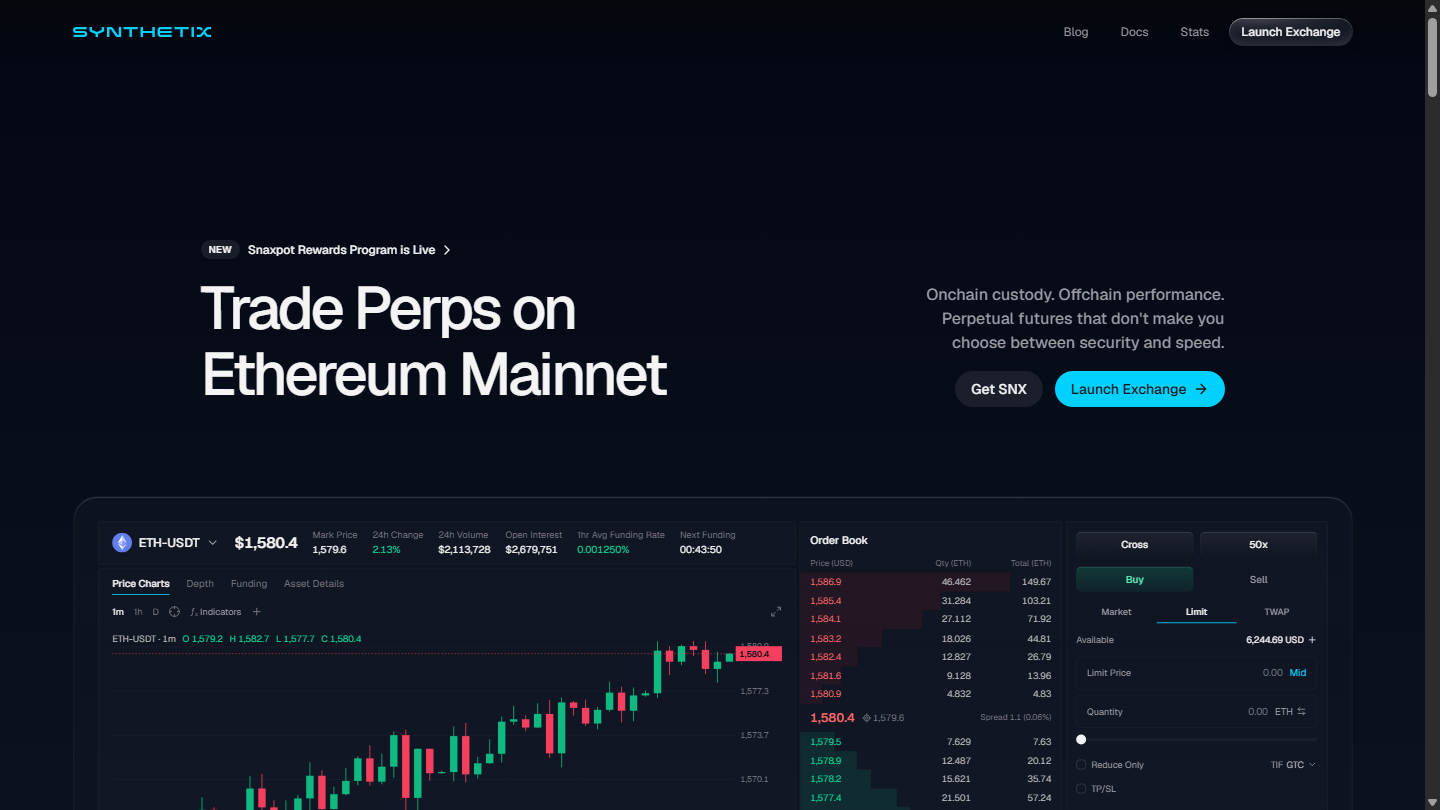
This design has a clear operational benefit. A trader can deposit, trade and withdraw on Ethereum Mainnet without a bridge route. It does not mean execution is identical to a centralized exchange: the matching engine, market liquidity, index price and onchain settlement path all remain dependencies. CoinLive’s guide to using a wallet with DEXs and dApps is useful context because the signature, network and allowance path are part of the trade, not administrative detail. The same operational boundary appears in CoinLive’s self-custody wake-up call: key control does not remove the need to verify a transaction path before capital is committed.
ETH and USDT margin change the account-level risk
The platform currently lists ETH and USDT as margin assets. USDT keeps the account’s collateral value close to its unit of account, while ETH lets a trader retain ETH exposure instead of selling it to open a perp. Neither choice is universally better because ETH collateral can fall while a position loses money, creating a second source of stress in the same account.
| Margin route | What it gives the trader | What can reduce account health |
|---|---|---|
| USDT margin | A comparatively stable account value against USDT-settled PnL | Trading losses, fees, funding payments and USDT debt |
| ETH margin | Retained ETH exposure and no need to sell the asset before trading | ETH price decline, the collateral haircut, trading losses, fees and funding |
| Combined collateral | More capital flexibility in one cross-margin sub-account | A loss on one position can interact with the value of every collateral asset |
| Collateral withdrawal | A way to reduce capital left on the venue | Less buffer can move the account closer to maintenance margin |
The table is a risk map, not a product ranking. USDT makes the collateral side easier to read, but it does not eliminate derivatives loss. ETH can be capital-efficient for an ETH holder, yet its value is reduced by the protocol’s haircut before account health is calculated. A trader holding ETH collateral should therefore regard an ETH drawdown and a losing long or short as potentially compounding events, not independent events.
Synthetix’s current multicollateral margin rules describe how non-USDT collateral is valued and adjusted. Before opening more than one position, the useful check is the sub-account’s adjusted value and maintenance requirement, rather than the isolated liquidation estimate shown for a single market.
Maker, taker, funding and tier fees form the real cost
The cost of a Synthetix Perps trade is not just the commission in the confirmation box. Maker and taker classification affects the open and close fee; funding changes while the position is held; and any tier status changes the rate a trader is shown. These elements should be recorded at entry because a low maker rate cannot offset a prolonged funding burden or a poor execution on an urgent close.
| Cost input | Where it applies | Why it needs its own check |
|---|---|---|
| Maker or taker fee | At opening and closing | The order type and execution path determine whether the trade receives or consumes liquidity |
| Funding | While the position remains open | It can accumulate against the crowded side and is not visible in a one-time commission quote |
| Tier rate | Across fee calculations | A published headline rate may not be the rate assigned to the connected account |
| Ethereum gas | Deposits, withdrawals and onchain settlement actions | It is separate from trading fees and can matter for small, frequent adjustments |
| Liquidation clearance fee | After the account becomes liquidatable | It is an additional loss path, calculated from liquidated notional rather than an ordinary trading fee |
The maker/taker field answers how the order entered the book. Funding answers what it costs to carry directional exposure after entry. Tier status changes the account-specific commission, and gas is an Ethereum transaction cost outside the matching fee. The clearance fee belongs in a different category entirely because it applies after risk controls have failed. Treating all five as one percentage hides the trade-offs that matter most.
The current fees page and funding guide should be checked immediately before trading. A practical record is the notional, selected order type, displayed fee tier, current funding rate and expected holding period. That record makes it possible to distinguish a fee problem from a price or execution problem after the position closes.
Liquidation starts with adjusted account value, not a single price line
| Liquidation field | Current Synthetix treatment | Trader implication |
|---|---|---|
| Adjusted account value | Includes collateral after the relevant valuation and haircut | ETH collateral is not counted at its unadjusted headline value |
| Maintenance margin | Minimum account value needed to keep positions open | The requirement applies at account level under cross-margin |
| Mark price | Uses external reference pricing rather than a single last trade | A visible order-book print is not the only price that matters in a stress event |
| Partial liquidation | Positions above 100,000 USDT can initially send 20% as a market liquidation order, followed by a 30-second cooldown | A large position can be reduced in stages rather than closed in one clean transaction |
| Clearance fee | Charged on liquidated notional; current examples list 0.5% for BTC/ETH and 1.0% for SOL and other markets | It is a separate forced-close cost, not a normal commission |
Synthetix liquidates an account when its adjusted account value falls below the maintenance-margin requirement. The live liquidation rules, updated August 28, 2026, identify four routes by which the margin buffer can shrink: position losses, funding or trading fees, rising USDT debt, and a haircut-adjusted fall in non-USDT collateral value.
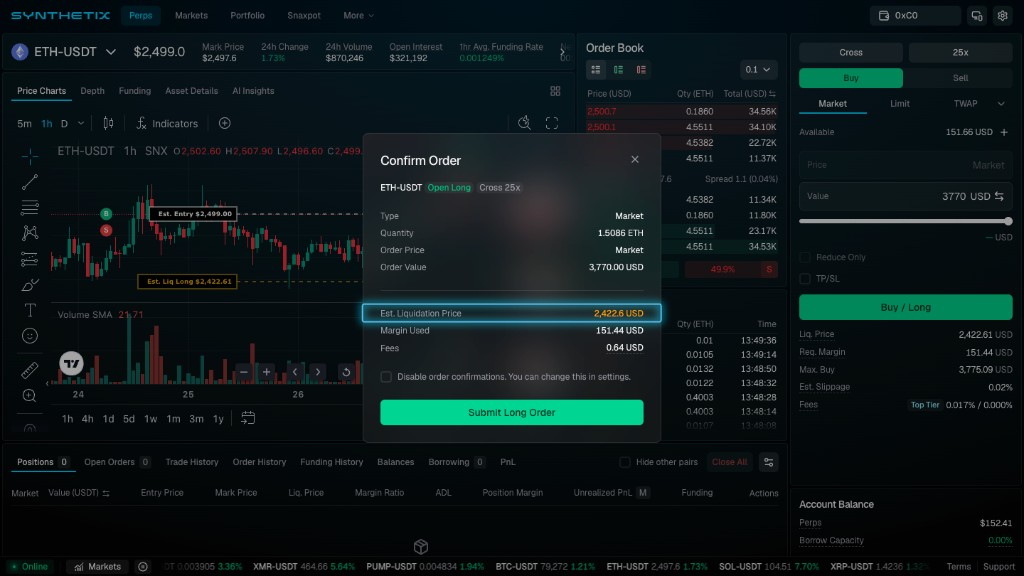
Every row changes the response to a fast market. The adjusted value and maintenance requirement show whether the whole account is healthy. The mark price means the displayed last trade alone is not sufficient for judging liquidation risk. Partial liquidation can leave a reduced account after the first action, while the clearance fee means that a forced close has its own cost layer. CoinLive’s report on a $439 million two-way liquidation event provides useful market context, but it does not replace the account-specific figures in the Synthetix interface.
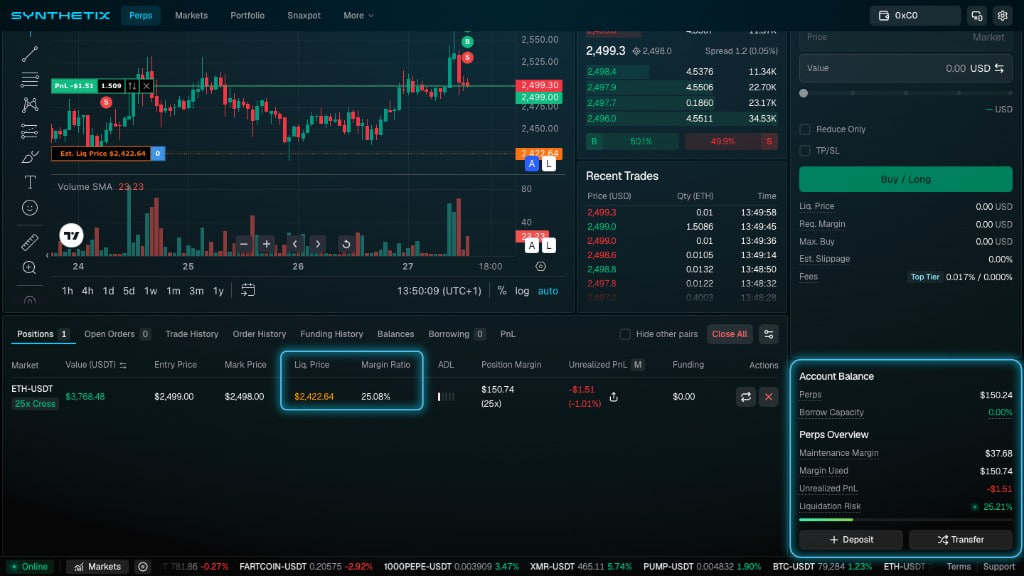
The estimated liquidation price is a planning aid, not a guarantee. Synthetix notes that it can move after entry as funding, PnL in other positions, collateral value and withdrawals change. Monitor margin ratio, maintenance margin, unrealized PnL and the platform’s liquidation-risk field after the position opens, especially when ETH is being used as collateral.
The SLP vault makes liquidity provision a separate decision
Synthetix’s SLP vault is the venue’s liquidity-provider route, not a feature that automatically improves a trader’s account safety. The protocol can transfer positions and collateral to designated SLP accounts during a liquidation process, which is why the vault belongs in an honest risk explanation even for a pure trader. It is the mechanism that can take over a stressed position, not a blanket insurance fund for deposits.
A Synthetix community member discussing delta-neutral structures described using Synthetix for perps while exploring LP and hedge combinations to smooth returns in choppy markets. The post is a first-hand account of one advanced workflow, collected September 16, 2026, not proof that the vault produces stable returns or reduces drawdowns. Its practical implication is direct: a trader should not combine directional perps and LP exposure unless the two risks can be measured separately.
For a reader considering the vault, the SLP vault terms should be read as a separate product decision. Pool returns, stressed-position transfers and withdrawal conditions are LP considerations. A perp trader should first establish a robust margin plan; adding vault exposure before that can make the total portfolio harder to understand.
Order types improve execution control but do not remove market risk
Synthetix supports market, limit, stop-loss, take-profit, scaled and TWAP orders. The set is valuable because different orders solve different execution problems: a limit order sets price discipline, a stop sets a loss boundary, a scaled order stages entry, and a TWAP reduces the need to send one large order at once. None of them changes the account’s cross-margin condition or removes the need for collateral headroom.
The operational mistake is to treat advanced order types as an automatic safety layer. A stop can be a sensible exit instruction, but funding, other-position PnL and the value of ETH collateral continue to change before it fills. CoinLive’s analysis of XRP open interest resetting after a long-liquidation wave is a reminder that execution controls and aggregate leverage are different variables.
Check the order-type behavior before using a new order style with size. Test a small market order, a limit cancellation and a modest withdrawal independently. That sequence exposes the actual matching and settlement workflow without assuming a feature label guarantees a favorable fill.
Best use cases and clear limits
Synthetix is strongest for an onchain trader who already holds ETH or USDT on Ethereum Mainnet, wants an offchain CLOB rather than an AMM curve, and can actively monitor a cross-margin account. It is especially relevant when avoiding a bridge and retaining ETH collateral changes the user’s workflow more than a marginal difference in trading commission.
It is a weak fit for a trader who needs every position to have isolated collateral, cannot monitor multiple positions, or treats ETH collateral as equivalent to stable collateral. It is also a poor fit for someone choosing a venue only from a claimed fee tier or leverage limit: the decisive inputs are current market depth, funding, account value, maintenance margin and the exact liquidation path.
Conclusion
Synthetix Perps has moved beyond the debt-pool framing used in many older reviews. The live product is an Ethereum Mainnet hybrid CLOB with ETH and USDT cross-margin, offchain matching and onchain custody. That is a distinctive trade-off: it can be highly practical for a mainnet-native trader, but it concentrates more decisions inside one account-level margin system.
The right way to use the venue is to begin with one collateral route, a small position and a documented margin buffer, then observe how funding, adjusted collateral value and the liquidation estimate move together. Scale only after the trade, close and withdrawal path has been tested under the current rules.
FAQs
Is Synthetix Perps still built around the old debt pool?
No. The current retail trading product is an Ethereum Mainnet hybrid CLOB with offchain order matching and onchain custody. Older debt-pool or L2 AMM explanations should not be used as a description of the live trading route.
Which assets can be used as margin?
Synthetix currently lists ETH and USDT as margin assets. ETH adds price and haircut risk to account health, while USDT makes collateral value easier to track against USDT-settled obligations.
Can a single position be assessed in isolation?
No. The account uses cross-margin, so adjusted collateral value, funding, fees and PnL from other open positions can affect the maintenance buffer and liquidation risk.
Does an estimated liquidation price stay fixed after entry?
No. It can change as funding accrues, other positions move, non-USDT collateral changes value or collateral is withdrawn.
Disclaimer: This article is for informational purposes only and does not constitute financial or investment advice. Cryptocurrency and digital asset markets carry significant risk. Always do your own research before making decisions.
More From Review
Hyperliquid Review 2026: Perpetual Trading, HLP, and Risks
Hyperliquid Review 2026 covering HyperCore order-book trading, deposits and withdrawals, margin, liquidation, HLP vault exposure, validators and the JELLY incid...
Lighter Perpetuals Review 2026: Order Book, Zero-Fee Claims, and Market Depth
A practical Lighter Perpetuals review covering order-book execution, zero-fee trading, funding, margin, liquidation, and Ethereum exit
