


Lighter Perpetuals Review 2026: Order Book, Zero-Fee Claims, and Market Depth
A practical Lighter Perpetuals review covering order-book execution, zero-fee trading, funding, margin, liquidation, and Ethereum exit
Lighter is a strong candidate for an active perpetuals trader who wants a visible order book, zero retail trading fees, and verifiable matching on an Ethereum-based ZK rollup. It is not a venue to choose from the fee headline alone: the relevant market still has to support the intended order size, the funding rate still changes the holding cost, and leverage still creates a hard liquidation boundary.
For a small, short-term trade, Lighter’s market and limit-order controls can make execution unusually transparent. For a larger or longer-held position, the decision turns on five observable items: cumulative depth, the average-fill limit, current funding, the market-specific margin requirement, and a completed withdrawal test. Those checks are more useful than a generic claim that an order book is deep or that a zero-fee venue is cheap.
Key takeaways
- Lighter’s order book is the product: inspect the executable depth at the intended size, not just the quoted spread at the best bid and ask.
- Retail trading fees can be zero while funding, price impact, an unfilled limit order, and Ethereum deposit or withdrawal costs still affect the result.
- BTC and ETH currently have a 50x maximum leverage and 2% initial margin in Lighter’s published specifications; smaller or riskier markets have materially lower limits, so the market selected matters as much as the leverage setting.
Lighter in practical terms
Lighter is a perpetuals exchange built as a custom zero-knowledge rollup that settles state changes against Ethereum. Its stated design is not merely “onchain trading”: it is a central order-book workflow in which signed actions, matching, liquidations, and state transitions are intended to be proven and verified under predefined rules. The distinction matters because an order book gives a trader direct control over price and order type, while the ZK design is meant to make the matching and risk path independently checkable rather than dependent only on an exchange operator.
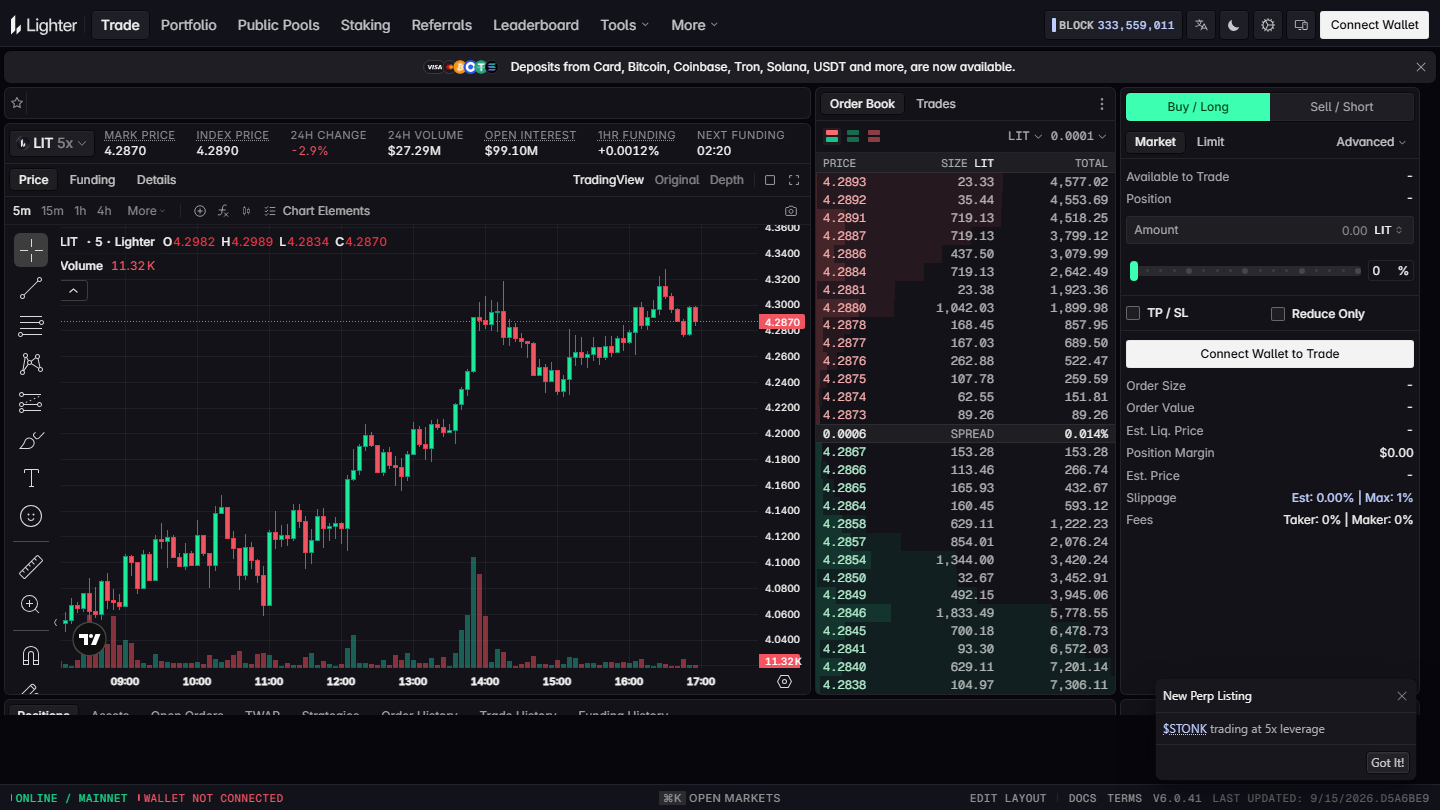
The live interface exposes the information a perpetuals trader actually needs before placing an order: mark and index prices, 24-hour volume, open interest, hourly funding, a depth ladder, a market/limit selector, a slippage control, and reduce-only protection. A connected wallet is still responsible for the transaction approval and the account’s collateral choices. Readers new to that workflow should understand how a wallet grants a DApp trading permission before treating self-custody as a substitute for operational discipline.
Lighter’s official product description says its matching and liquidations are proven on Ethereum, while its technical architecture describes a sequencer, prover, and Ethereum-posted state data. That is a meaningful design choice, but it does not turn every visible quote into available liquidity or every wallet transaction into a completed exit. The trading decision remains market-specific.
Order-book execution is the core Lighter test
Lighter’s order-matching rules use price-time priority. A taker order consumes the best available order first, then continues through the book until it is filled or no crossing liquidity remains. A market order can carry an average execution-price limit; if later fills would exceed that limit, it can be partially filled. This is a useful control, but a partial fill can leave a trader with less exposure than planned or an incomplete close during a fast move.
The right pre-trade check is therefore cumulative, not cosmetic. Read the full amount available through the intended limit price, compare the estimated average fill against the index and mark price, and repeat the same check on the opposite side of the book. The second check matters because opening a long against a liquid ask does not prove that selling the position later will be equally clean. The liquidation losses reported during volatile crypto sessions are a reminder that an orderly screen can change rapidly once forced reductions begin.
| Execution field | What Lighter shows or permits | Practical reading |
|---|---|---|
| Best bid and ask | Top price on each side of the order book | A tight top-of-book spread is only the starting point; it does not describe the next levels. |
| Cumulative depth | Quantities resting at successive prices | Add the levels needed for the actual order size and measure the price reached. |
| Average execution-price limit | A market-order safeguard against filling too far from the mid-price | Set it before submitting a market order; a protective limit can create a partial fill. |
| Post-only limit order | A limit order that cancels rather than crosses and becomes taker flow | Useful for price control, but it may never execute when the market moves away. |
| Reduce-only order | An instruction that can only move the position closer to zero | Use it for exits so an oversize order cannot reverse the position. |
| TWAP | Repeated market-order slices over a selected duration | It may reduce one-shot impact, but each slice still depends on live depth and can partially fill. |
None of these fields should be analysed in isolation. A trader who sees a narrow spread but ignores cumulative depth is measuring the first dollar of the order, not the whole trade. A trader who uses post-only to avoid crossing the spread gains price control but accepts non-execution risk. A trader who sets a strict average-fill cap controls adverse slippage but must have a plan for the unfilled balance. Lighter provides the tools; the order design determines whether those tools reduce or merely relocate execution risk.
A public bot-trading account of a Lighter user, retrieved September 16, 2026, illustrates the operational cost behind those controls. The trader described deploying low-open-interest, market-making, and funding-cycle strategies; early iterations required recurring code fixes and a BTC/ETH spread test generated more than $1 million of volume in three days with a small loss before the strategy was changed. That is one user’s report, not proof of platform-wide execution quality or strategy profitability. Its useful lesson is narrower: API or bot users should start with restricted permissions, log every fill and cancellation, and test a small notional through a volatile session before allowing automation to scale.
Zero fees change the cost stack, not the trading risk
Lighter advertises zero fees for retail trading, and the public interface displayed a zero maker and taker fee when reviewed on September 16, 2026. That is a direct advantage over venues that charge a percentage each time a position opens or closes. It does not mean a perpetual trade has no carrying cost. Funding transfers between longs and shorts at the market’s published interval, and the interface itself displays the current one-hour funding rate alongside the order book.
The published contract specifications state that each deployed market currently has a one-hour funding period, while also warning that the configuration can differ on new deployments. Holding a position through eight funding windows is eight separate exposures to the rate, not one vague “funding cost.” Before holding overnight, record the current rate and its sign, inspect whether the market has been persistently imbalanced, and calculate the result against the actual notional rather than the collateral posted.
| Cost or constraint | What changes it | Why it can matter more than a zero trade fee |
|---|---|---|
| Bid-ask spread | Market, time of day, and available resting orders | It is paid in the fill price when crossing the book to enter or exit. |
| Price impact | Order size relative to cumulative depth | A larger market order can consume multiple price levels even when the top quote is tight. |
| Funding | Long/short imbalance and the market’s hourly funding calculation | It accumulates while a position remains open and can outweigh a small one-time fee. |
| Partial fill | Average-price cap, thin liquidity, or a limit order that does not cross | It can leave only part of the planned entry or close live. |
| Ethereum transaction cost | Deposit, withdrawal, and the user’s chosen transaction route | The exchange may charge no trading fee while the wallet still pays for settlement actions. |
| Liquidation loss | Margin, price movement, funding, and the mark-price path | This is the dominant risk when the account approaches maintenance margin. |
The two tables above cover different decisions. The first is an execution checklist for an individual order; the second is the cost stack for the full position. Together they show why comparing Lighter only on maker/taker fees misses the practical decision. The all-in result is the realized entry price plus funding plus the realized exit price, after any blockchain settlement costs. Open-interest resets following long liquidations show why funding and depth should be checked together rather than treated as separate dashboard numbers.
LIT tokenomics and the post-TGE valuation debate
LIT matters to this review because Lighter routes exchange economics toward the token, but the token must be evaluated on a different evidence set from a perpetual order. The widely shared March 2026 snapshot of roughly $1.01 to $1.03 per LIT implied an FDV near $1 billion against a 1 billion-token maximum supply. It is not a current price reference: historical market data for September 14 showed LIT near $4.39, which implies an FDV above $4 billion on that same maximum-supply basis. Readers should always date a price, circulating supply, and FDV together rather than compare a March token snapshot with a later market condition.
The comparison with Lighter’s reported $1.5 billion fundraising valuation also needs a strict boundary. Fortune’s report on the $68 million round described a company valuation tied to equity and token warrants, not a disclosed public LIT purchase price or a simple token-FDV conversion. That means a token trading below a company valuation does not prove that Founders Fund, Ribbit Capital, Haun Ventures, or Robinhood are down by a specific percentage. Their warrant terms, equity economics, and any hedge activity are not public in the sources reviewed, so a claim that they have or have not hedged should not be used as an investment conclusion.
| Token issue | Verified position | What it changes for a LIT holder |
|---|---|---|
| Maximum supply | LIT’s maximum and total supply are listed as 1 billion tokens. | FDV is sensitive to price even when the currently tradable float is much smaller. |
| Allocation | Tokenomics.com lists 26% for team, 24% for investors, 25% for ecosystem, and 25% for the airdrop. | Team plus investor allocation is 50% of supply, so the future unlock calendar is a central supply-risk input. |
| Team and investor vesting | The same tracker lists a 12-month cliff followed by 36 months of linear vesting for both groups. | The cliff date and monthly unlock amount matter more than a broad claim that insiders are “locked.” |
| Ecosystem allocation | The tracker lists 25% but does not publish a complete release schedule for it. | This is a genuine transparency gap; it is not evidence that ecosystem tokens are being sold. |
| Revenue-funded token action | Reporting on Lighter’s July update says approximately 15.5 million LIT bought with revenue through Q2 were moved into a permanent burn. | The figure was about 6.3% of the then-circulating supply, not 6.3% of the 1 billion maximum supply. |
| Business activity | A recent DefiLlama snapshot showed about $697.7 million TVL and $5.44 million in 30-day fees. | Revenue and TVL can support buybacks, but neither proves future volume, market share, or token performance. |
The allocation row is the bear case that deserves the most precise language. A 26% team allocation plus 24% investor allocation is larger insider exposure than some traders are comfortable with, and the Ecosystem release schedule is not fully specified in the tracker reviewed. However, no primary source reviewed here verifies the claim that roughly 90% of airdrop recipients sold or that current selling comes from the Ecosystem allocation. Those are community hypotheses, not evidence of a supply source. The same standard applies to accusations of price manipulation: without attributable, independently supported evidence, they do not belong in a protocol review as established fact.
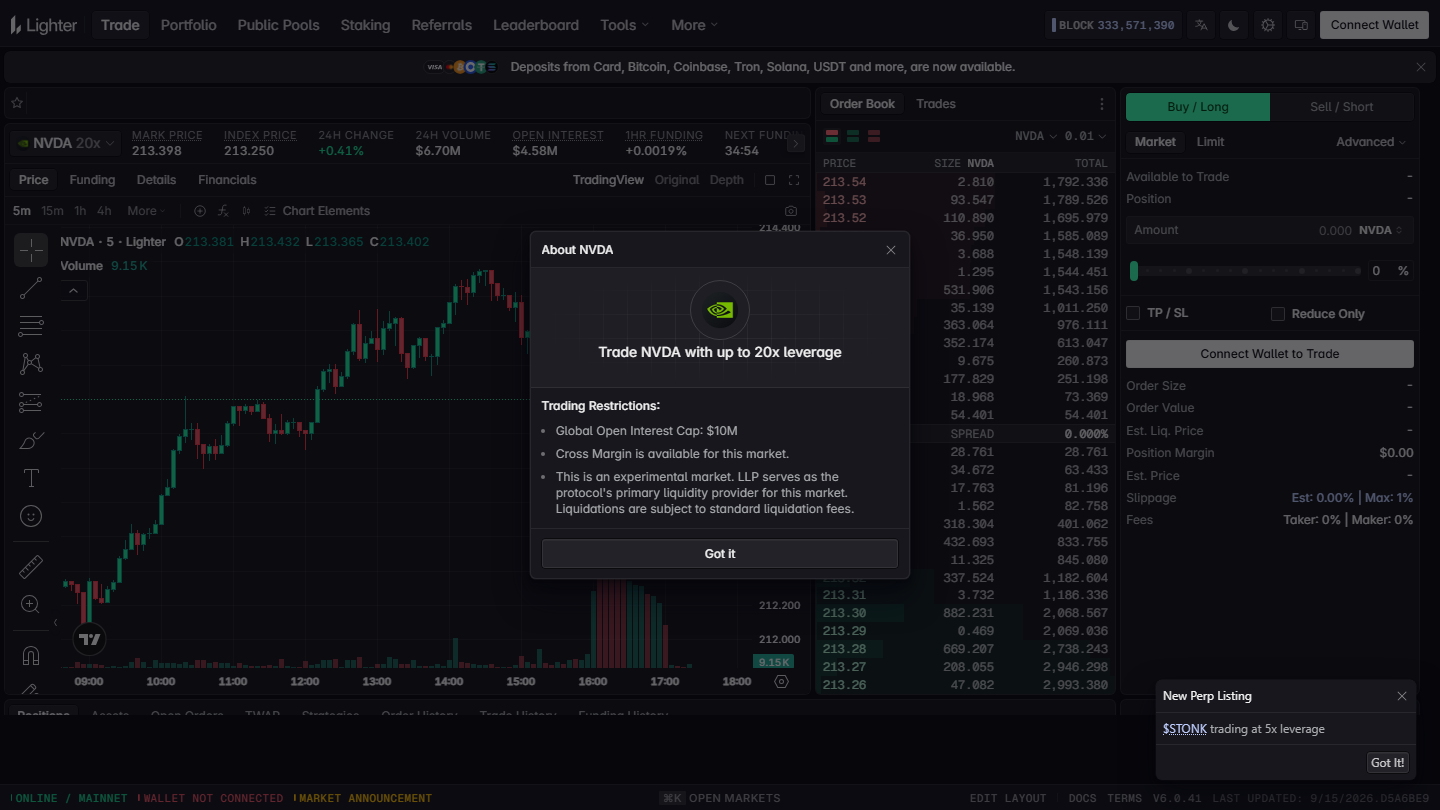
The bull case is also narrower than a price target. Lighter’s July update changed its revenue-funded repurchases into a burn mechanism; contemporaneous reporting put the first burn at about 15.5 million LIT. The platform is also expanding its trading catalogue beyond crypto. Its published RWA market specifications cover selected equities, commodities, FX pairs, and ETF-linked markets with individual open-interest caps and oracle references. These facts support a case that the product is pursuing broader demand, but the thesis still has to be validated by sustained execution, revenue, and market-specific liquidity rather than by the listing count.
For LIT holders, the useful monitoring list is concrete: track the next unlock event, disclose any Ecosystem distribution with a source, compare burned tokens with any newly issued rewards, and watch fees, TVL, open interest, and active depth after incentives change. That gives a clearer answer than guessing whether a fund has hedged. It also connects the token discussion to the earlier order-book analysis: a sustainable token mechanism ultimately depends on traders continuing to use markets they can enter and exit efficiently.
Margin and liquidation vary by market
Lighter does not apply one leverage rule to every perpetual. Its current specification lists BTC and ETH at up to 50x leverage with a 2% initial-margin requirement, SOL at 25x with 4% initial margin, XRP at 20x with 5%, and many smaller markets at 10x, 8x, 5x, or 3x. The same table publishes maintenance and close-out margin requirements. A trader selecting a smaller market is accepting a wider risk cushion and a lower maximum leverage by design, not merely a different ticker.
| Market example | Maximum leverage | Initial margin | Maintenance margin | Close-out margin | Trading implication |
|---|---|---|---|---|---|
| BTC | 50x | 2.0% | 1.2% | 0.8% | The narrow margin band makes leverage selection and stop placement consequential even in a highly followed market. |
| ETH | 50x | 2.0% | 1.2% | 0.8% | The formal thresholds match BTC, but current order-book depth and funding must still be checked separately. |
| SOL | 25x | 4.0% | 2.4% | 1.6% | Lower permitted leverage reflects a wider margin requirement than BTC and ETH. |
| XRP | 20x | 5.0% | 3.0% | 2.0% | A position has a larger posted-margin requirement, but it can still be liquidated before a discretionary exit fills. |
| 10x market example | 10x | 10.0% | 6.0% | 4.0% | Treat the product as a distinct risk case, not as a 50x BTC setting with a different chart. |
| 5x market example | 5x | 20.0% | 12.0% | 8.0% | The lower cap reduces leverage but does not create a low-risk or guaranteed-liquid market. |
The market table should be read row by row. BTC and ETH allow the highest headline leverage and share the same published margin fractions, but that does not make their live books interchangeable. SOL and XRP require more margin and permit less leverage, which changes both the size possible for a given collateral balance and the distance to maintenance margin. The 10x and 5x rows make the broader point: a smaller market’s risk is determined by its own margin parameters, price behavior, and exit depth.
Lighter’s matching engine also checks account health after trades and can cancel orders that would make a healthy account unhealthy. That protects the book from orders that should not be executable under its rules, but it does not protect a trader from adverse price movement after a fill. Use reduce-only orders to manage an exit, keep a margin buffer that is larger than the displayed minimum, and avoid sizing solely from a maximum-leverage label. Readers comparing leverage mechanics across venues can use CoinLive’s guide to collateral reuse risk as context for why collateral structure is part of the position, not idle background.
Custody and withdrawal controls deserve a separate check
The strongest protocol-specific claim in Lighter’s design is its exit architecture. Its published Core architecture says that Ethereum contracts hold deposited assets and the canonical state root, while the priority queue is designed to carry withdrawal, pool-exit, and reduce-only IOC requests. If the sequencer does not process those requests in time, the stated Escape Hatch mode lets users reconstruct state from Ethereum-posted data and prove their claim directly on Ethereum.
This is more concrete than a generic self-custody slogan, but it should be treated as an architecture and workflow to verify, not a reason to skip a test. A trader should confirm the current deposit route, make a small deposit, open and close a modest position, withdraw, and reconcile the wallet balance before increasing collateral. That process turns Lighter’s stated exit design into an observed route for the user’s own wallet and region. It also reflects why self-custody still requires active operational controls, including correct signing, address verification, and a backup plan for access.
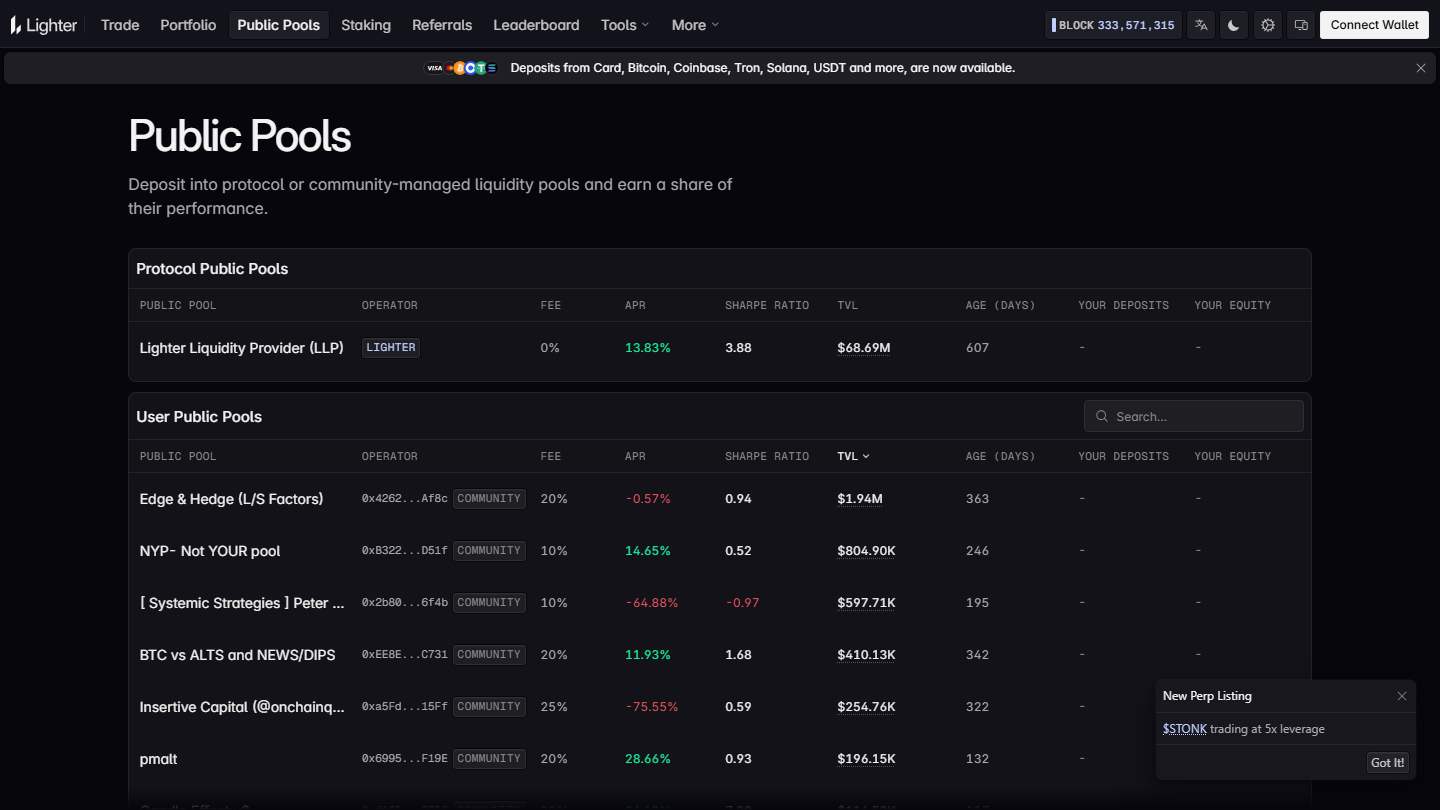
Public Pools are a different product boundary. Lighter’s published pool rules say pool operators trade through subaccounts and participants receive pool shares; a pool does not support isolated positions. That is not equivalent to placing a self-directed perpetual order. A depositor must assess operator behavior, pool terms, and pooled-margin exposure separately rather than importing the order-book analysis from a personal trading account.
Where Lighter is strongest and where it demands more work
Lighter is compelling for an experienced trader who values price-time priority, can read depth, and wants direct controls such as post-only, reduce-only, stop, take-profit, and TWAP orders. The best use case is not “any trader who wants zero fees.” It is a trader who will inspect the exact BTC, ETH, SOL, XRP, or other market before entering, define an acceptable average fill, and revisit funding before carrying the position.
The trade-off is that Lighter asks the user to do more than compare an advertised fee. A passive trader can misread visible depth, fail to account for partial execution, or discover that the selected market’s leverage and margin profile differs from the headline example. Its ZK verification and Ethereum exit mechanism address specific protocol and operator risks; they do not eliminate price risk, liquidation risk, or the need to monitor an open leveraged position.
Conclusion
Lighter is a credible order-book perpetuals venue for active users who will validate the full trade path. Its zero retail fee is meaningful, and its verifiable matching plus Ethereum-oriented exit design give the product a differentiated technical case. The verdict changes if the target market cannot absorb the intended size, the funding rate makes the holding period uneconomic, or a withdrawal has not yet been tested from the user’s own wallet.
LIT adds a separate supply-and-revenue decision. The known inputs are the allocation mix, future insider cliffs, the incomplete Ecosystem release detail, and revenue-funded burns; fund hedging, ecosystem selling, and market-manipulation claims remain unverified. Use Lighter with a market-specific process: measure both sides of the book, set a price-protection rule, read the relevant margin row, calculate funding at the actual notional, and test the exit with small capital. Those actions turn the review into an execution decision rather than a claim about the brand.
Frequently asked questions
Is Lighter really zero-fee for perpetual trading?
Lighter’s public interface showed zero maker and taker fees for retail trading when reviewed on September 16, 2026. That does not remove spread, price impact, funding, Ethereum settlement costs, or liquidation risk, so the complete position cost must include entry and exit conditions.
Can a Lighter market order fill at a worse price than expected?
Yes. A market order consumes available orders by price-time priority. Lighter allows an average execution-price limit; if further fills would exceed that limit, the order can be partially filled instead of continuing at a worse average price.
Does Lighter use the same leverage and margin requirements for every market?
No. The published specifications list different leverage, initial-margin, maintenance-margin, and close-out-margin values by market. BTC and ETH are currently listed at 50x maximum leverage, while other markets have lower caps and higher margin requirements.
What should be tested before moving significant collateral to Lighter?
Complete a small deposit, order, reduction or close, and withdrawal under the current deployment. Then compare the recorded fill price, funding, collateral balance, and wallet transaction cost with the values shown before the trade.
Disclaimer: This article is for informational purposes only and does not constitute financial or investment advice. Cryptocurrency and digital asset markets carry significant risk. Always do your own research before making decisions.
More From Review

Synthetix Perps Review 2026: Mainnet CLOB, Multi-Collateral, and Liquidation Risk
A practical Synthetix Perps review covering its Ethereum Mainnet CLOB, ETH and USDT margin, fees, funding, liquidation route, SLP vault, and trader risk.
Hyperliquid Review 2026: Perpetual Trading, HLP, and Risks
Hyperliquid Review 2026 covering HyperCore order-book trading, deposits and withdrawals, margin, liquidation, HLP vault exposure, validators and the JELLY incid...
