


Meteora Review 2026: Solana’s Liquidity Layer, From DLMM Bins to the LIBRA Lawsuit
ReviewMeteora review examining Solana DLMM liquidity bins, LP fees, wallet usability, published audits and the platform’s exposure to the LIBRA dispute.
Meteora is a Solana liquidity platform built around DLMM, a concentrated-liquidity design that places capital into discrete price bins, alongside its DAMM pools and launch tools. This review covers what I could see and verify on 9 November 2026, and where the evidence stops.
Quick verdict: Meteora is one of the most capable places to provide liquidity on Solana, with dynamic fees, flexible position shapes and published audits. The trade-offs are an interface built for active LPs, a long list of fresh memecoin pools, active management risk, and a legal cloud from the 2025 LIBRA token launch.
| Item | Detail |
|---|---|
| Best for | Active liquidity providers on Solana and token teams launching markets |
| Fees | Pool-level base fee plus an optional variable fee, a share goes to the protocol, plus Solana network fees |
| Custody | Non-custodial, you connect your own wallet |
| Audits | Sherlock reviews of DLMM, plus Offside Labs and OtterSec audits listed for DAMM v2 |
| Editorial score | 3.8 / 5 |
What I tested, and what I did not
I opened app.meteora.ag on desktop (1440px), tablet (1024px) and phone (430px), read the protocol revenues docs and the DLMM overview, then connected a throwaway MetaMask wallet that holds no funds, using MetaMask’s Solana option. I did not create a position, add liquidity, swap or claim anything, so claims about real yields, impermanent loss and gas come from documentation and community reports, not my own pools. My first connection attempt failed because a welcome dialog covered the page, and a second attempt worked once I found the MetaMask option, described below.
What Meteora actually is
Meteora’s home page opens with “We build liquidity pools” and aims at liquidity providers, launchpads and token launches. At capture it showed $266.71M total value locked, $369.07B in swap volume and $2.05B in fees generated. Those are the app’s headline figures and I did not verify them independently.
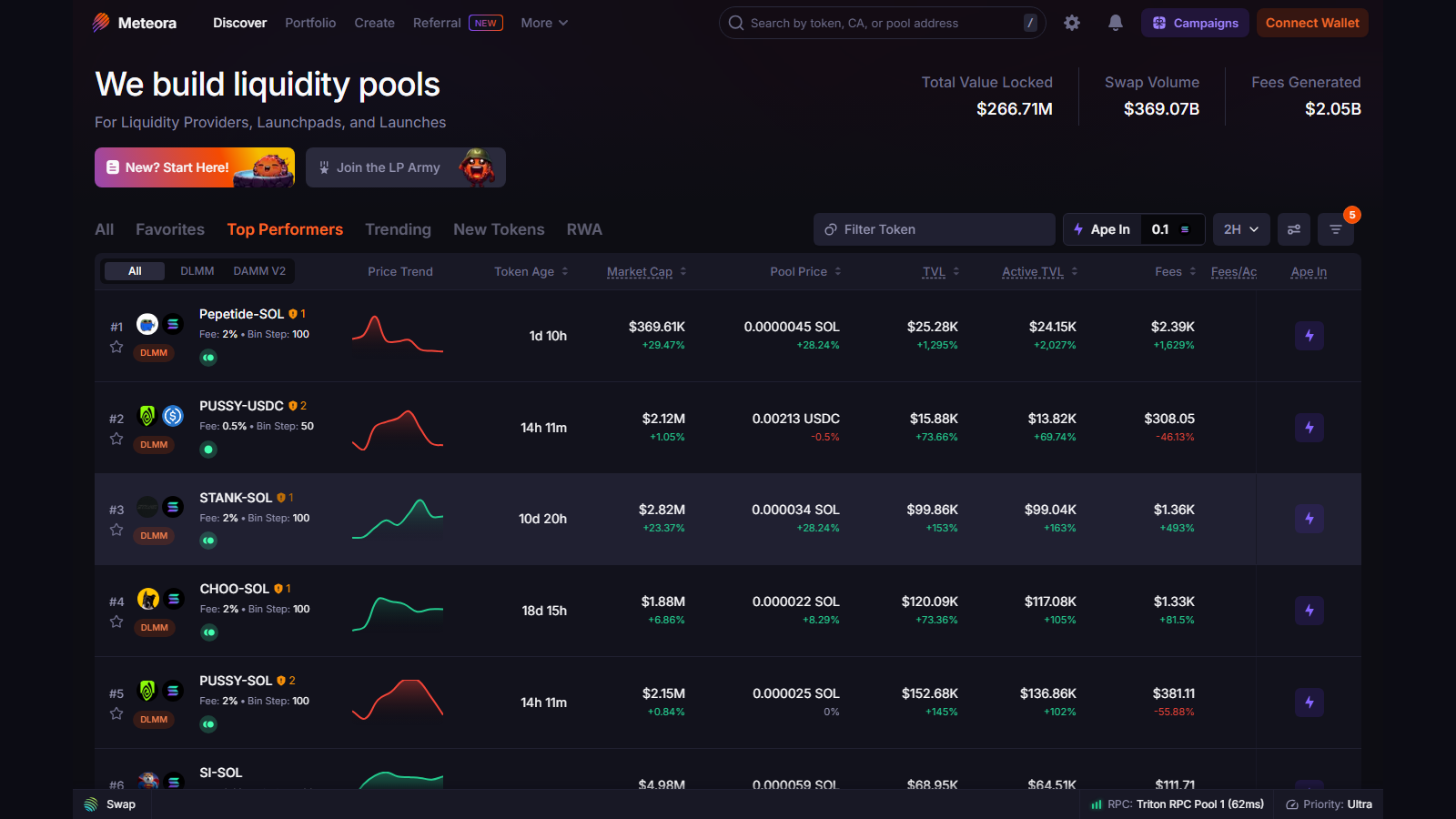
The table is the main surface. Each row shows a pool such as Pepetide-SOL or PUSSY-USDC, its fee (2% and 0.5% in the rows I saw), its bin step, token age, market cap and TVL. Many of the top rows were tokens only hours or days old, which tells you where much of the activity sits and also how risky it can be.
How DLMM works
According to the DLMM docs, liquidity is organized into discrete price bins. Trades inside the active bin execute at that bin’s fixed price, so there is no slippage within the bin, and when a bin is used up the market moves to the next one. LPs can choose Spot, Curve or Bid-Ask shapes, make single-sided deposits, and use dynamic fees that rise when volatility rises. Unlike DAMM pools, DLMM liquidity is not connected to Meteora’s Dynamic Vaults for lending yield.
The practical upside is capital efficiency, since liquidity sits where trades happen. The practical downside is that your range can go out of range, stop earning fees and leave you holding the weaker asset. In an old r/solana thread on how people LP profitably, a commenter recommends picking pools on older memecoins that are past the ruggable stage and says the strategy suits experienced users, while another asks why anyone would prefer Meteora over Orca. That thread is about two years old, so I use it only to show how LPs talk about the trade-offs.
Using Meteora on desktop, tablet and phone
On tablet the table drops columns such as TVL and fees, keeping price trend, market cap and pool price.
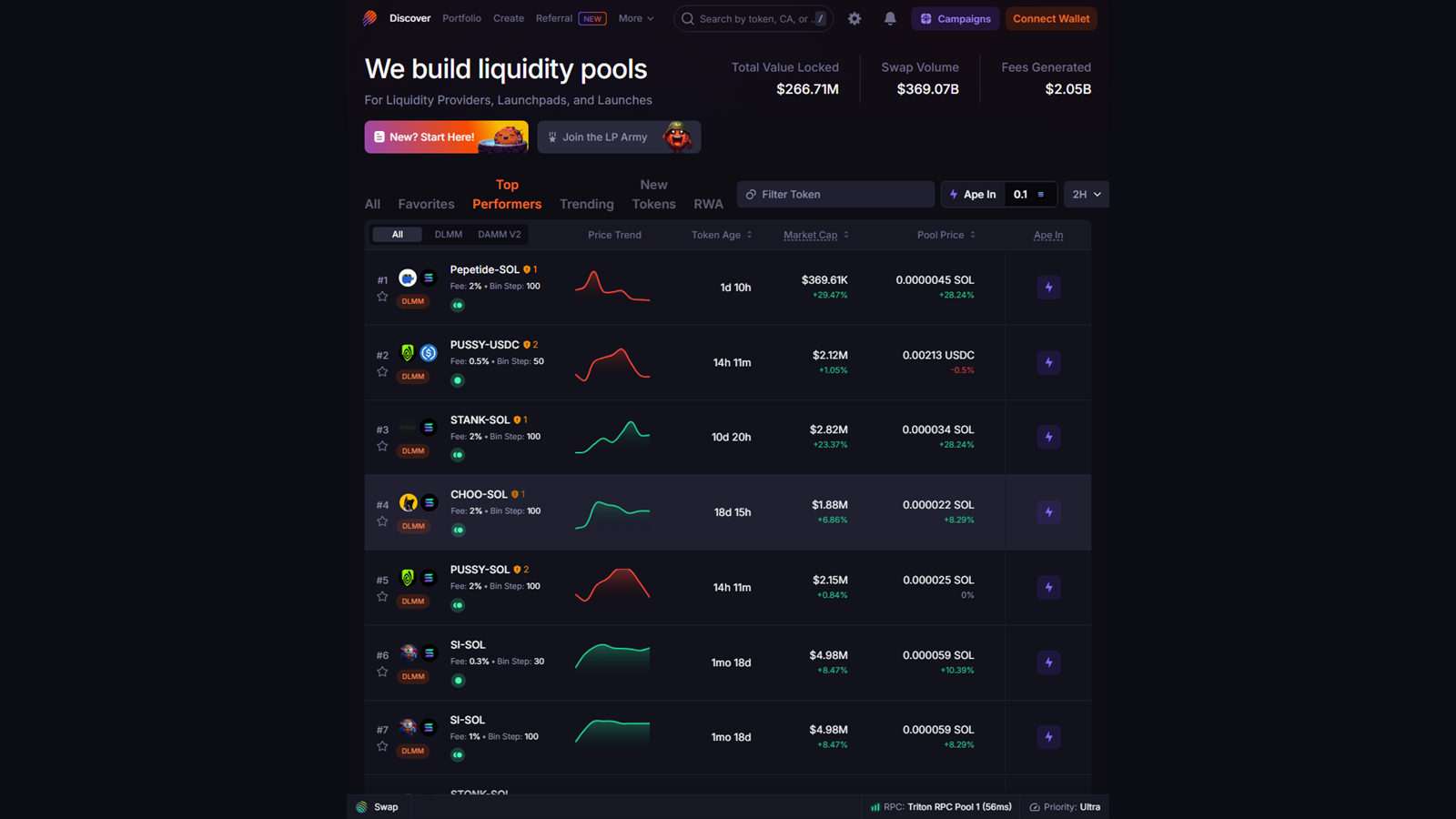
On phone the page becomes a stacked list with a Connect button at the top and a bottom bar showing RPC latency and priority fee setting.
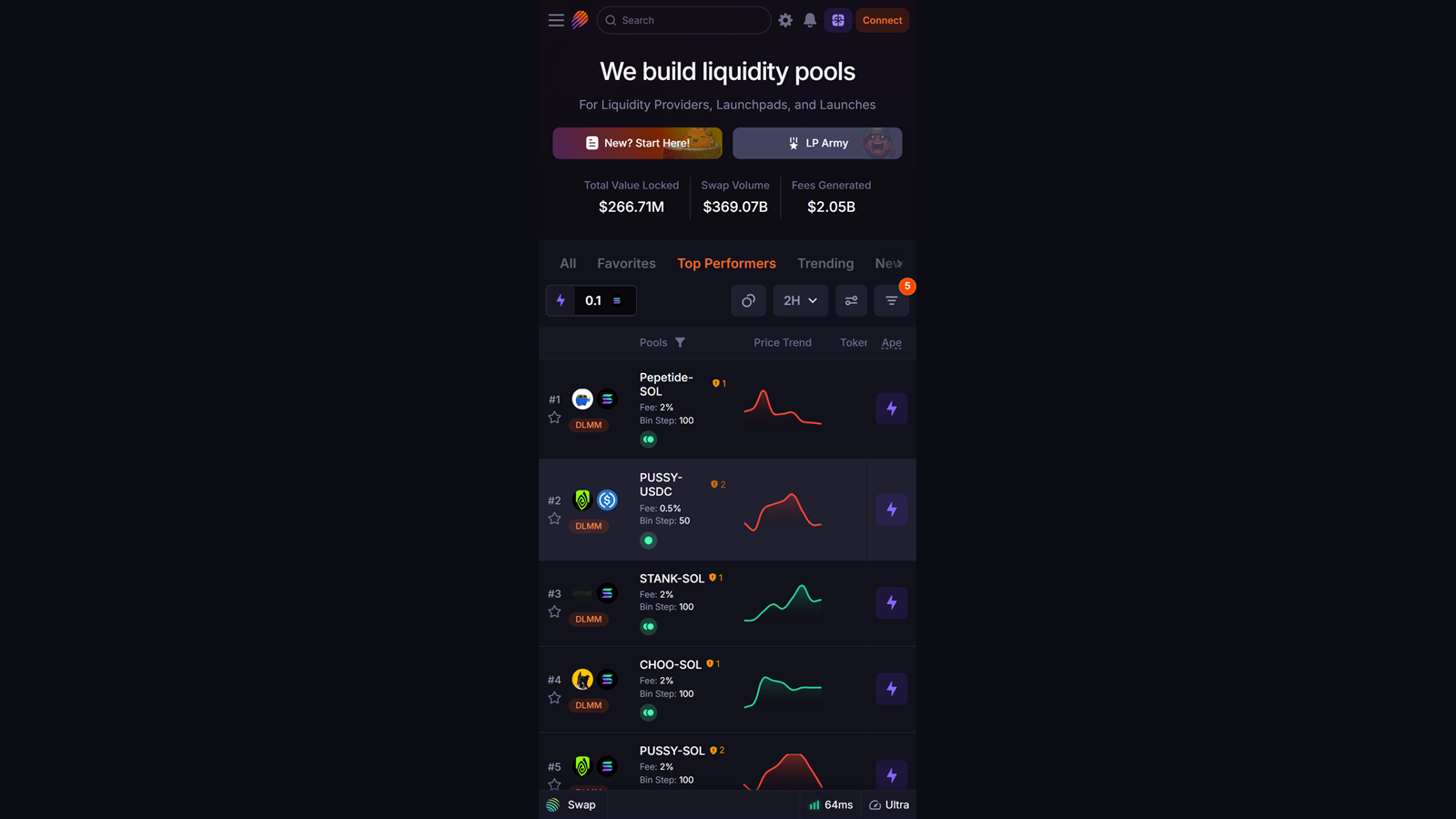
Best for: scanning on any device and managing positions on desktop.
Connecting a wallet
A welcome dialog asks you to accept the terms of service before you can use the page. After that, the Connect Wallet modal lists Jupiter as recommended, then Phantom, Solflare, Backpack, Coinbase Wallet and OKX Wallet, plus Socials and WalletConnect. MetaMask is not named in the main list, and I only found it through small wallet icons under “More Wallets”.
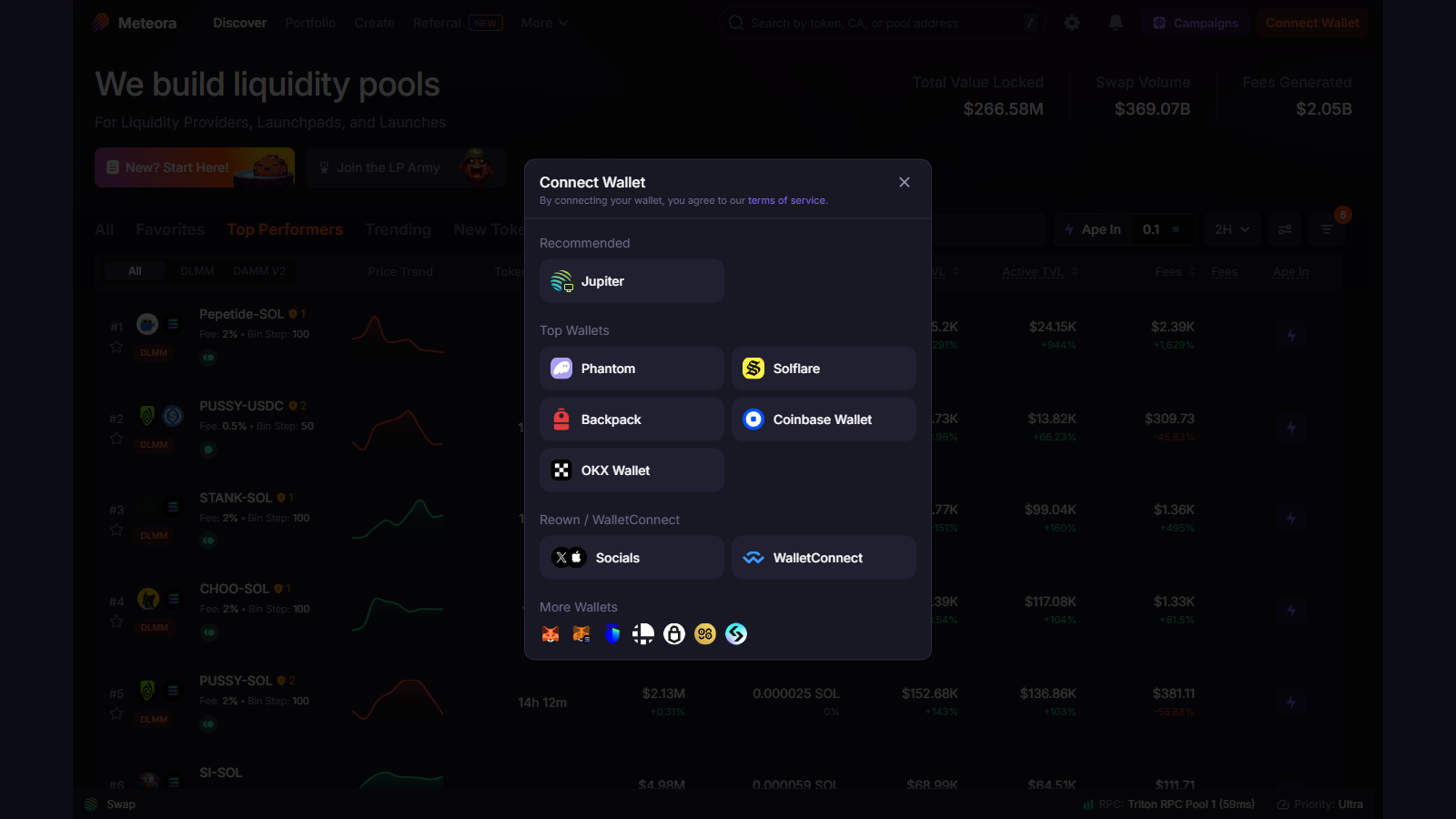
Connect modal. The MetaMask fox sits in the row of icons at the bottom, not in the named list. Clicking the fox icon opened a normal MetaMask window asking to connect to app.meteora.ag.
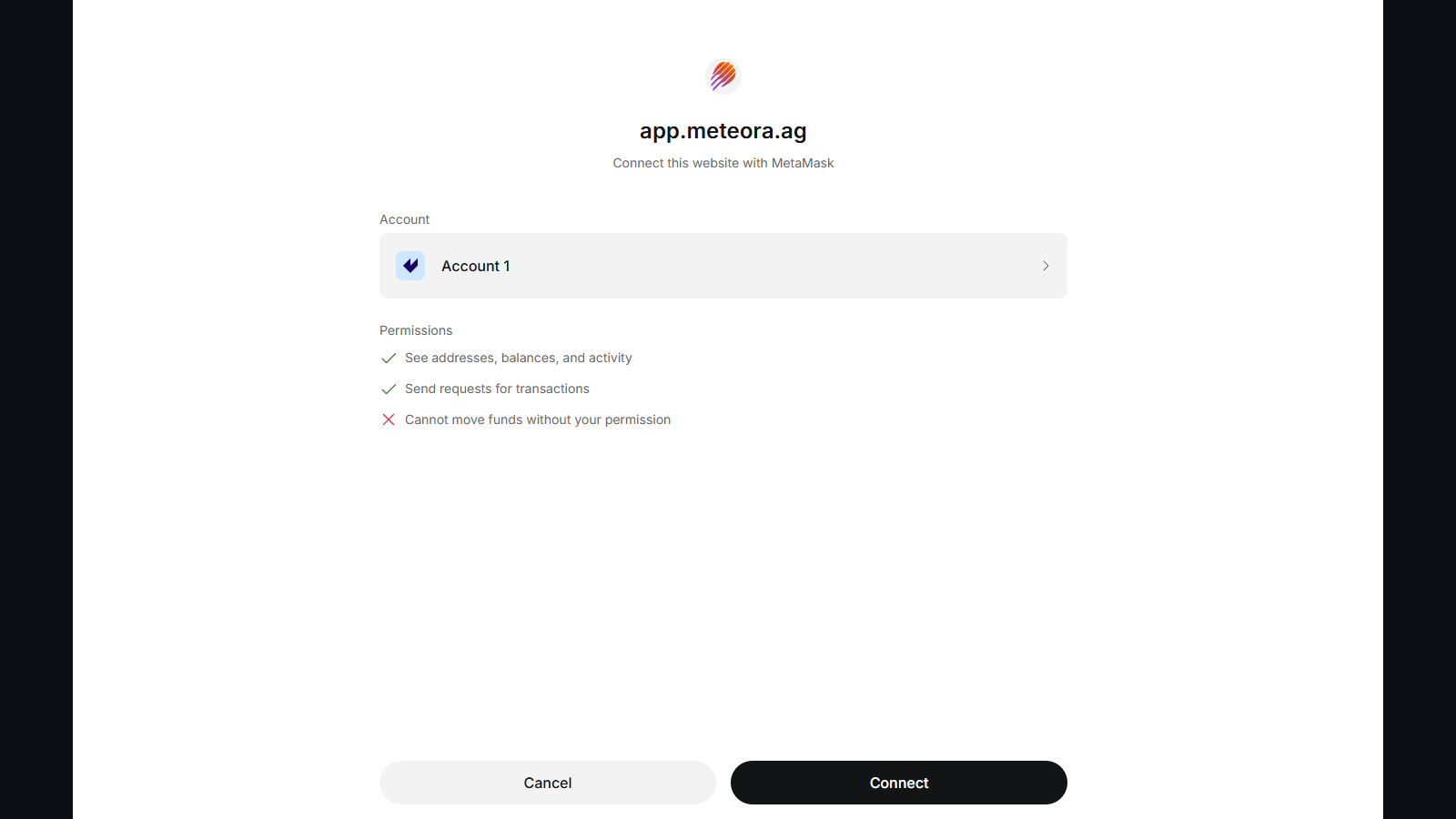
MetaMask connect request. It states the site cannot move funds without your permission. After approval, the header showed 0.00 SOL and a shortened address.
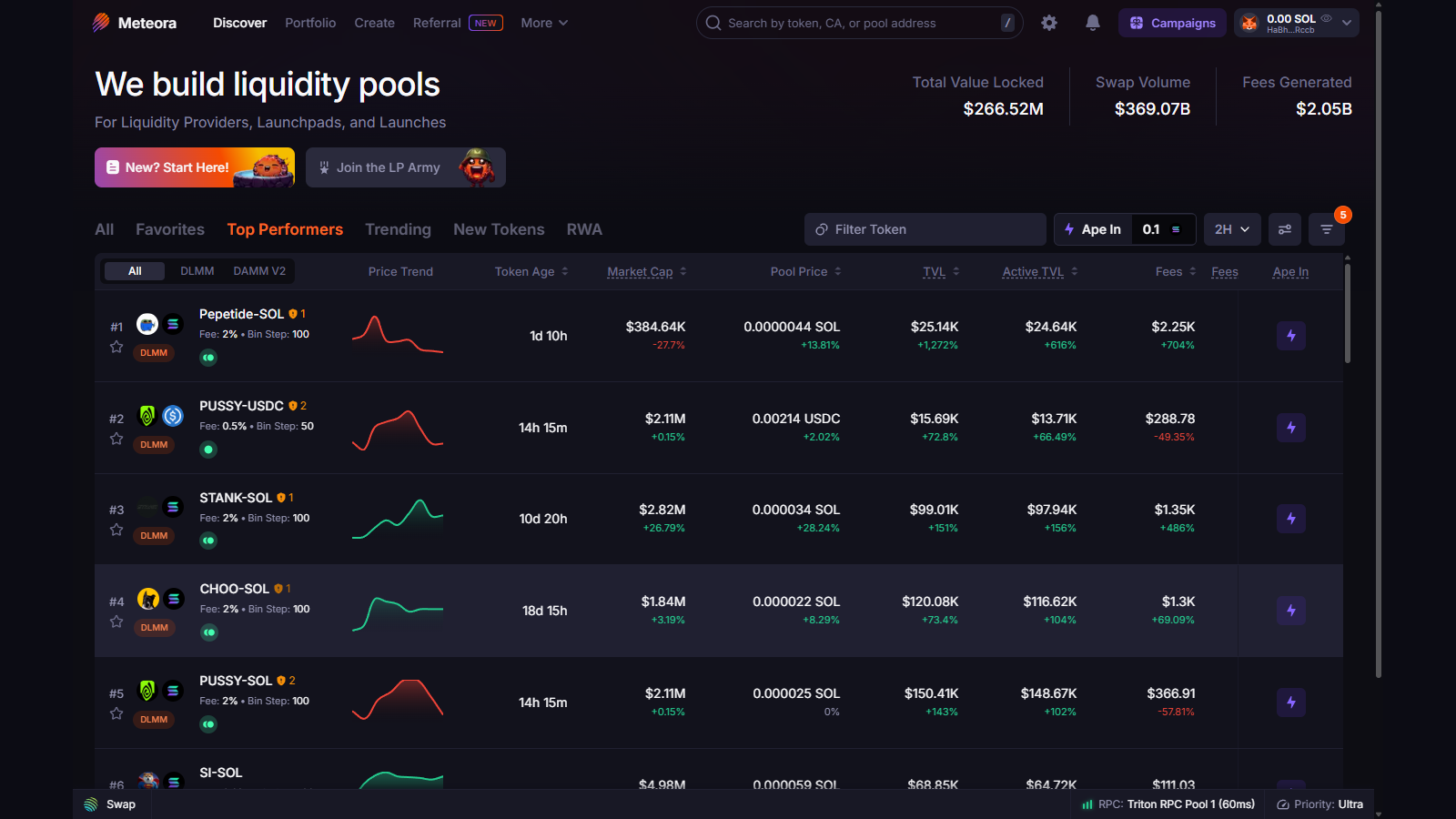
Connected state. The balance reads 0.00 SOL because the wallet is empty, and I did not open any pool. I did not need to sign a message to connect.
Fees and costs
The docs say fees on DLMM have a base fee and an optional variable fee, and that the pool first calculates the total trading fee, then splits it between LPs, market makers, limit order owners, launch partners, token creators, the protocol and optional referral or host accounts, depending on the product. The protocol fee percentage applies to the trading fee, not to the full swap amount. I did not capture the exact percentages, so check the docs for the product you use.
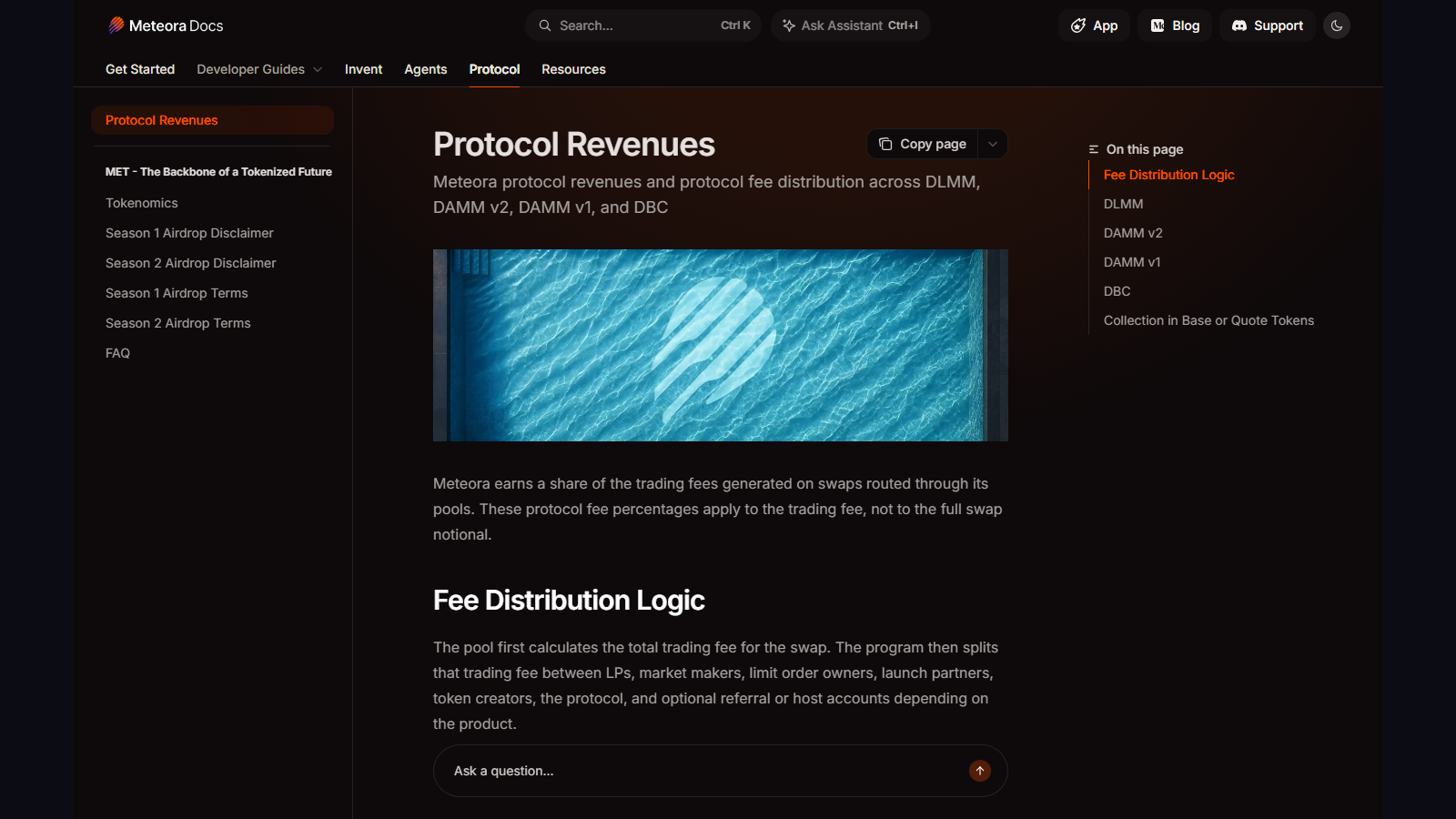
Beyond protocol fees you pay Solana network and priority fees, and the bottom bar of the app shows a priority fee setting. A real LP cost I could not measure is impermanent loss, which depends on the range you pick.
Security and audits
Sherlock’s case study on Meteora says it completed three collaborative audits and found 17 DLMM findings, and gives Meteora’s H1 2026 activity as $32.1B in volume with 26.7% of Solana spot AMM fees. Those figures come from an auditor’s marketing page, so treat them as claims. A search result for the DAMM v2 audits page lists Offside Labs and OtterSec audits. I did not read the reports, so I cannot say which findings were fixed.
The LIBRA controversy
In February 2025, the LIBRA token launched by Kelsier Ventures became a major Solana scandal. BeInCrypto reported that Burwick Law filed a class action in New York against KIP, Meteora and Kelsier, alleging an unfair and misleading token launch. These are allegations from a complaint, not findings of a court, and I did not find an outcome. I mention it because it is the kind of reputational and legal risk that sits next to a platform that hosts many new token launches.
Who should use Meteora
Good fit:
- LPs who are comfortable managing ranges and rebalancing
- Token teams that need configurable launch pools
- Solana users who want more control than a basic AMM gives
Think twice:
- Beginners who do not understand impermanent loss
- Anyone chasing the newest pools, since many tokens are hours old
- Users who want a platform with no litigation attached to its history
FAQ
Is Meteora safe?
It is non-custodial and its DLMM code has been reviewed by named firms, but providing liquidity carries impermanent loss and token risk, and you should read the LIBRA allegations before deciding.
What is DLMM?
Dynamic Liquidity Market Maker. It puts liquidity into discrete price bins with dynamic fees.
Can I use MetaMask?
Yes, through its Solana option. It was not in the main wallet list, only in the small icon row under More Wallets.
Do I need an account?
No. You connect a wallet. I connected an empty MetaMask wallet and saw 0.00 SOL in the header.
Disclaimer: This article is for informational purposes only and does not constitute financial or investment advice. Cryptocurrency and digital asset markets carry significant risk. Always do your own research before making decisions.
More From Review
Across Review 2026: An Intents-Based Bridge, and What the July Relayer Incident Showed
Across Protocol review covering intent-based bridging, relayer fees, wallet support, security audits and lessons from the July 2026 incident.
Best Web3 Consulting Firms in 2026
Six Web3 consulting firms compared, with self-reported figures from their official sites, plus how to scope, vet and price an engagement.

Ondo Finance Review 2026: USDY, OUSG, Ondo Stocks and ONDO
A screenshot-based review of Ondo Finance in November 2026: the USDY and OUSG product pages, Ondo Stocks, the app, the wallet connect modal, live numbers from D...

4Dlabs (@4Dlabs_Official), Season 1 In-Depth Review & Airdrop Positioning Playbook
4Dlabs (4dlabs.space / dapp.4dlabs.space / @4DlabsOfficial) represents a vital infrastructure breakthrough at the intersection of Web3, robotics, and…
Entropy.io Review (2026): Markets, Trading Tools, Fees, and Risks
A hands-on look at Entropy.io’s public trading interface, with screenshots of pre-IPO, stock and ETF markets, plus fees, risks and competitors.

Aster DEX Review 2026: Perp Trading, asBNB Yield, and the 1001x Leverage Question
Aster combines perpetual futures up to 1001x leverage, spot trading, and yield products like asBNB and USDF across multiple chains. Read the honest review, incl...
