


dYdX Review 2026: Complete Beginner’s Guide to the Perpetuals Exchange, MegaVault and the DYDX Token
ReviewdYdX Review 2026 covers perpetual trading, fees, MegaVault limits and DYDX token risks, with hands-on findings to help beginners assess the exchange.

Who This Guide Is For
This guide is for readers who have seen dYdX called one of the first big decentralized derivatives exchanges and want to know where it stands now. You may have traded perpetual futures on a centralized exchange and wonder what changes when the order book sits on a blockchain. You may be a holder of the DYDX token. Or you may only be curious about the MegaVault yield product. You do not need prior knowledge. We explain each term when it first appears.
A short plain definition first. A perpetual future, or “perp”, is a contract that follows the price of an asset such as ETH and has no expiry date. You can take a long position, which gains when the price rises, or a short position, which gains when it falls. You can also borrow, which is called leverage, so a small deposit controls a bigger position. Leverage makes gains and losses larger, and a loss of your whole deposit is a normal result of a bad trade.
We opened the live app on a desktop browser and went through every public page we could load. We also tried to sign in with a throwaway MetaMask wallet holding zero funds. The wallet connection was approved, but dYdX then asked for a message signature to create a dYdX Chain wallet, and we declined it. Because of that we never reached the funded account view. The order form, the portfolio and the vault deposit box all stayed locked behind a “Recover keys” button. Every section of this review says what we saw and what we did not.
How We Tested dYdX
| Area | What we did | Result |
|---|---|---|
| Desktop browser, 1440 x 900 | Opened Markets, the ETH-USD trade screen, MegaVault, Portfolio, Referrals, the DYDX page and the More menu | Loaded and captured |
| Wallet | Throwaway MetaMask with zero balance | Connect request approved. The app then asked for a free signature to create a dYdX Chain wallet. We declined it. No account was created |
| Order form | Looked at the Buy and Sell form on ETH-USD | Visible, with the main button reading Recover keys. No quote and no order preview |
| Fees page | Opened Portfolio, Fees | Fee tiers readable. Our own tier showed the default |
| Market numbers | Read the Markets table and header stats | Captured |
| Token and TVL numbers | CoinGecko, DefiLlama, GitHub, pulled on November 25, 2026 | Cross-checked |
We used the desktop view only. We did not capture tablet or phone views.
On the signature. MetaMask and the app both said the signing was free and would not send a transaction. We still chose not to do it, because our rule for this series is that we never sign anything with the demo wallet. We state this plainly so you can weigh how far our hands-on goes. It means we saw the exchange as a visitor and we did not place or preview an order.
Quick Verdict
Pros: dYdX is a serious, open source perpetuals exchange with a clean trading screen, a tiered fee table, a public referral leaderboard and a long record of audits.
Cons: Its market has shrunk a lot. Daily volume was under $90 million on the day we checked, most of it in one market, the vault product has been restricted by a community vote and the DYDX token hit an all time low four days before our check.
| Item | Detail |
|---|---|
| Project | dYdX, app at dydx.trade, docs at docs.dydx.xyz |
| Products | Perpetual futures exchange, MegaVault, referral program, staking, liquidation rebates |
| Chain | dYdX Chain, a Cosmos based chain built only for this exchange |
| Token | DYDX, used for staking, governance and fee discounts |
| Our editorial score | 3.6 out of 5 |
| Wallet needed to browse | No |
| Money at risk in our test | None |
What Is dYdX (Plain English)
Most big crypto trading happens on a centralized exchange. You deposit coins with a company, and the company runs an order book, which is the list of offers to buy and sell. dYdX keeps the same style of order book but moves it onto its own blockchain. The validators of that chain match orders, and your funds sit in your own account on the chain instead of in a company’s wallet.
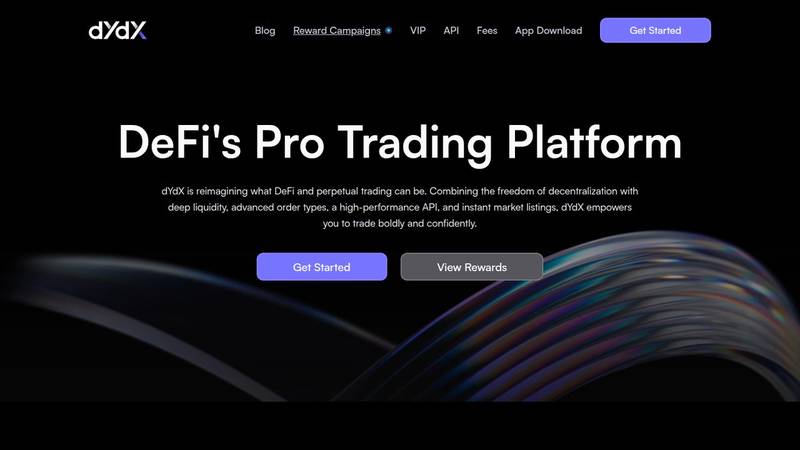
Think of an auction house that publishes every bid in public and holds the goods in a glass case anyone can inspect. You still deal with a professional auctioneer’s rules, but nobody can quietly change a bid. In dYdX the glass case is the dYdX Chain, and the auctioneer’s rules are the code that the community controls through the DYDX token.
dYdX launched in 2017 on Ethereum. The older version, called V3, ran on a scaling layer and is now small. The current version, V4, started in late 2023 as its own chain. The footer of the site says it is operated by the dYdX Ops subDAO using software open sourced by dYdX Trading Inc. A subDAO is a smaller group within the community’s governance.
Key Facts
| Fact | Detail | Source |
|---|---|---|
| 24 hour trading volume | About $87.6 million | dydx.trade Markets |
| Open interest | About $48.8 million | dydx.trade Markets |
| Fees generated, 24 hours | About $7,000 | dydx.trade Markets |
| Share of volume in ETH-USD | About $73.2 million, roughly 83% | dydx.trade Markets |
| Maximum leverage | 50x on ETH and BTC, 20x on SOL, 5x to 10x on most others | dydx.trade |
| Default fee tier | 0.010% maker, 0.050% taker | dydx.trade Fees |
| V4 TVL on DefiLlama | About $62.3 million, from about $69.3 million 30 days ago | DefiLlama |
| V4 TVL peak | About $415.5 million, December 2024 | DefiLlama |
| V3 TVL | About $5.4 million | DefiLlama |
| MegaVault TVL shown in header | $1,848,573, estimated APR 7% | dydx.trade |
| DYDX price | About $0.066 | CoinGecko |
| DYDX market cap | About $56 million | CoinGecko |
| Audit reports on GitHub | 7 PDFs from Informal Systems | GitHub |
The App, Page by Page
Markets
The Markets page opens with three stat boxes: 24 hour trading volume of about $87.6 million, current open interest of about $48.8 million and fees generated in 24 hours of about $7,000. Below them is a searchable table with category filters, including Meme, AI and Big Data, DeFi, DePIN, Layer 1, Layer 2, RWA, Gaming and Forex. A switch shows “launchable markets”, which are markets that anyone can start, and the table has three pages.
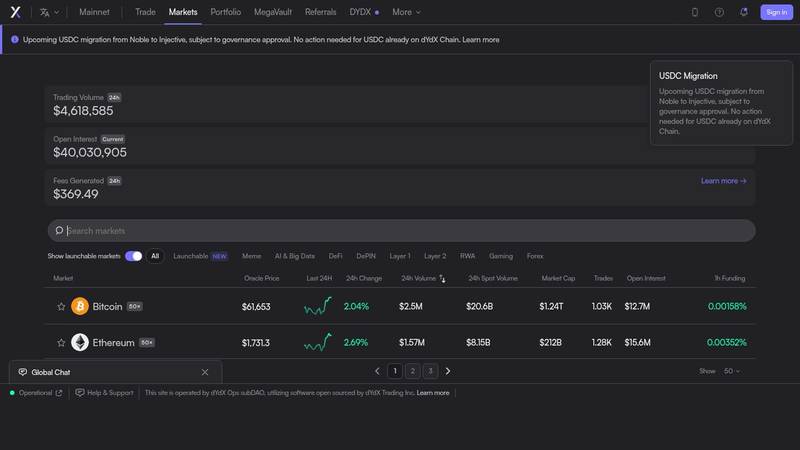
Each row shows the oracle price, a 24 hour mini chart, the 24 hour change, the 24 hour volume, the spot volume of the asset elsewhere, the market cap, the number of trades, the open interest and the 1 hour funding rate. Funding is a small payment that flows between long and short traders every hour so that the perp price stays close to the real price. A positive rate means longs pay shorts.
The volume was very uneven. ETH-USD had about $73.2 million of the $87.6 million, BTC-USD about $13 million and SOL-USD about $1.05 million. Many other markets showed only a few thousand dollars of volume. A market with a few thousand dollars of daily volume can have wide gaps in its order book, so a market order may fill at a bad price.
A banner at the top of every page says a migration of USDC from Noble to Injective is planned, subject to governance approval, and that no action is needed for USDC already on dYdX Chain. We did not read the proposal.
Connecting a wallet
The Sign in link is in the header. We approved the MetaMask connection. Then a dialog titled “Sign message” appeared. It said that signatures are used to verify ownership and wallet compatibility, that new users receive two signature requests, and that signing is free and does not send a transaction. The first request was named “Generate your dYdX Chain wallet”. We closed the flow here.
The app then marked our account as needing recovery. On the trade page the main button read Recover keys, the Portfolio page said that “one or more of your keys needs to be recovered”, and the same button appeared on Referrals and MegaVault. In plain words, a visitor who connects and does not sign gets an account that looks half set up.
The trade screen
The ETH-USD screen is a classic exchange layout. The left side has a price chart with indicators, order lines and buy and sell markers, with tabs for Price, Depth, Funding and Details. A top bar shows the oracle price of $1,645.9, a 24 hour change of $24 or 1.44%, 24 hour volume of $73.2 million, 4,781 trades, open interest of 11,675.91 ETH, a 1 hour funding rate of 0.00051%, a countdown to the next funding and a maximum leverage of 50x.
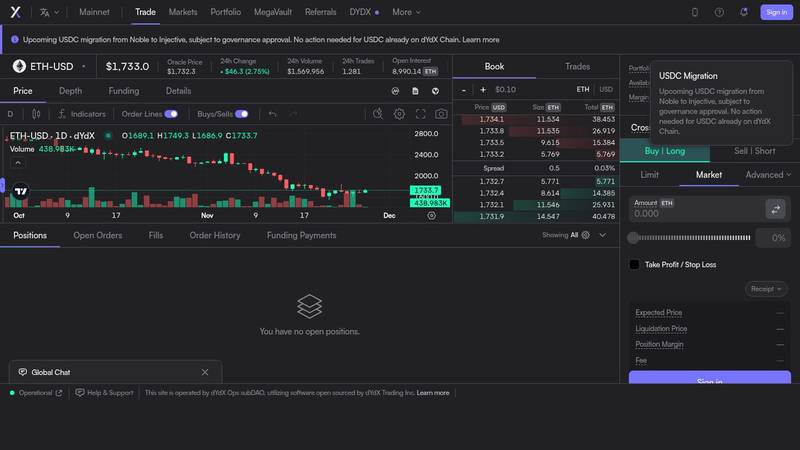
In the middle is the order book with a price column, a size column and a total column, and the spread was 2.6, which is 0.16%. The order form on the right has Cross and Isolated margin modes, a leverage selector set to 50x, Buy or Long and Sell or Short tabs, Limit, Market and Advanced order types, an amount box, a slider and a Take Profit or Stop Loss switch. Under it, a Receipt section lists the expected price, the liquidation price, the position margin and the fee. All those fields were blank, because we had no funds and no signed account. The bottom panel has Positions, Open Orders, Fills, Order History and Funding Payments.
Cross margin shares your whole balance among positions, so one bad trade can use all of it. Isolated margin limits a position to the amount you set aside for it. The liquidation price is the price at which the exchange closes a position by force because the margin is gone.
MegaVault
MegaVault is dYdX’s pooled product. You add USDC to a shared vault, and a market making program trades on your behalf. The header showed an estimated APR of 7% and a TVL of $1,848,573. The chart on the page showed a Vault P&L reading of $4,704,621 on November 25, 2026, up $10,338 or 0.54%, and a smooth upward line over 30 days. We could not explain why the chart value is higher than the TVL in the header.
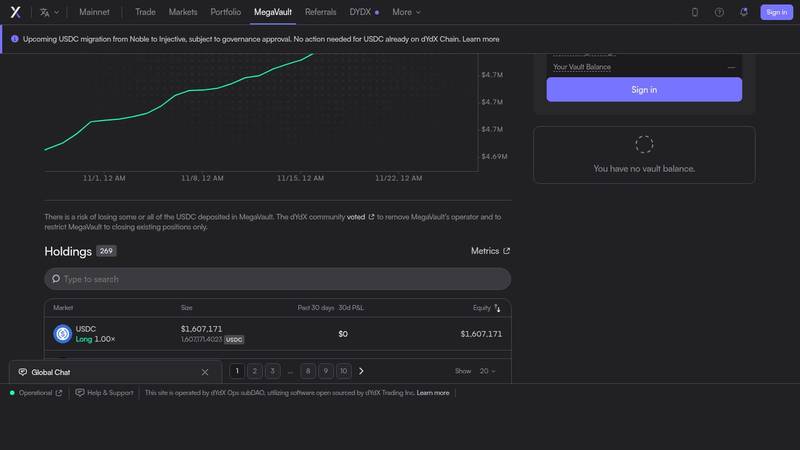
The most important text on the page is a warning. It says there is a risk of losing some or all of the USDC deposited in MegaVault, and that the dYdX community voted to remove MegaVault’s operator and to restrict MegaVault to closing existing positions only. That means the vault is winding down its trading, and a new depositor would be joining a product that its own community has chosen to restrict. The holdings list showed 269 entries. At the top was a USDC balance of $1,607,088 and then a long tail of small positions in coins such as SOL, BTC, ETH and XRP, each in the low thousands of dollars.
The deposit box has Add funds and Remove funds tabs, an amount field and a Max button. For us the button read Recover keys, so we saw no quote.
Portfolio and fees
The Portfolio page has Overview, Positions, Orders, History, Other and Fees tabs, plus an Equity Tiers section. For our empty account the overview was blank and only showed the recovery message.
The Fees tab was useful without an account. Our fee tier was Tier 1, which charges 0.010% for makers and 0.050% for takers. A maker adds an order to the book, and a taker removes one. The tiers fall with 30 day volume.
| Tier | 30 day volume | Maker | Taker |
|---|---|---|---|
| 1 | $0 | 0.010% | 0.050% |
| 2 | $1M | 0.010% | 0.045% |
| 3 | $5M | 0.005% | 0.040% |
| 4 | $25M | 0.000% | 0.035% |
| 5 | $50M | 0.000% | 0.030% |
| 6 | $100M | 0.007% | 0.025% |
| 7 | $200M | 0.011% | 0.025% |
A separate Staking Tiers table gives a discount to people who stake DYDX. Ours showed none, with 0.00% off. The tier 6 and 7 maker rows show a small positive fee, and we did not look into why. At tier 1, a $10,000 market buy costs about $5 in fees.
Referrals
The Affiliates Program page promises lifetime commissions to people who refer traders. It said to connect a wallet to see our data. Below it was a public leaderboard. The first row showed earnings of $132K, $13.3B of referred volume and 796 users referred. The numbers are large compared with the current exchange volume, which tells us the referral boom happened in earlier, busier months. The leaderboard is a useful sign that real trading flows once came through partners.
The DYDX page and menus
The DYDX page has a Liquidation Rebates panel, described as up to $1 million in rebates. Traders who are liquidated on non-BTC perpetual pairs may earn DYDX rebates on part of their losses. Below it is a stake box with Unstaked, Staked and Total balance, all at 0.0000 for us, and a help list that covers rewards, staking and risks. A long note says staking and governance are provided by third parties, with variable reward rates and slashing risk.
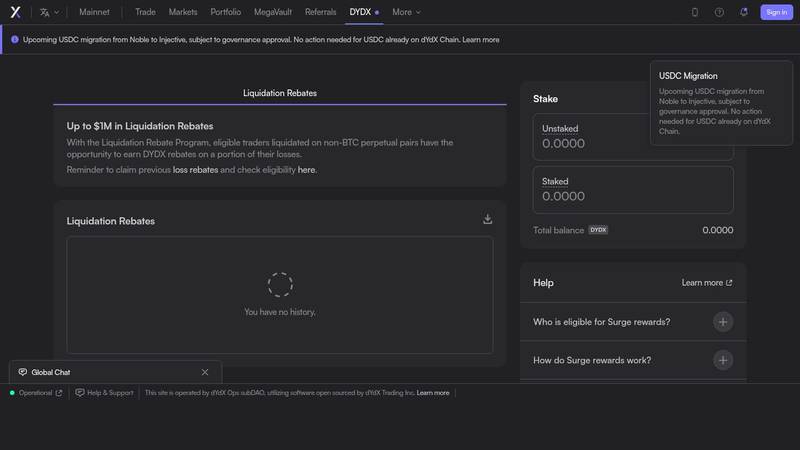
The More menu lists API Documentation, API Trading Keys, Mintscan (a block explorer), Funding Comparison, Community, Terms of Use, Privacy Policy, Help and Statistics.
A Worked Example for Beginners
Numbers on a perps screen can look abstract, so here is a simple example using values we saw on the ETH-USD screen. This is an illustration, not a trade we made, and it ignores funding to keep the maths short.
Suppose ETH trades at $1,646 and you open a long with $1,000 of your own money at 10x leverage. Your position is worth $10,000, which is about 6.07 ETH. If ETH rises 5% to about $1,728, your position gains about $500, which is half of your deposit. If ETH falls 5%, you lose about $500. If ETH falls about 10%, the position is close to being liquidated, because a 10% fall on a 10x position removes the entire $1,000 of margin, and the exchange closes it a little earlier to protect itself.
At the base fee tier a taker pays 0.050%. Opening a $10,000 position as a taker costs about $5, and closing it costs another $5. Those are small next to the price risk, but they add up if you trade often. A maker order, which waits in the book, costs 0.010% at the same tier.
Now put the same trade at 50x, the maximum we saw on ETH. A $200 deposit controls the same $10,000. A fall of about 2% removes the whole deposit. That is why a high leverage number on a screen is not a feature to chase. It is the speed at which you can lose.
Finally, funding. In the table we saw a 1 hour rate of 0.00051% on ETH, which is about 0.012% a day if it stays the same. On a $10,000 long that is roughly $1.20 a day paid to shorts. The rate changes and can be negative. On BTC the 1 hour rate was higher at 0.00314%, which is roughly 0.075% a day. Over a month a crowded long can cost real money even when the price does not move.
Nothing in this example is a prediction. It is only a way to read the form on the right side of the trade screen once your account is set up.
The DYDX Token
DYDX is the token of the dYdX Chain. Holders stake it to help secure the chain with validators, vote on proposals and receive a discount on trading fees through the staking tiers. Staking rewards and any share of trading fees depend on the current governance rules, and we did not read them in detail.
The market numbers are weak. CoinGecko showed a price of about $0.066, a market cap of about $56.0 million and a fully diluted value of about $63.4 million. Of a maximum supply of 1 billion, about 958 million exist in total and about 846 million circulate. The all time high was $4.52 on March 7, 2024. The all time low was $0.066 on November 21, 2026, only four days before our check, so the token sits at its lowest price ever. It is down about 98.5% from the peak.
| DYDX measure | Value | Source |
|---|---|---|
| Price | About $0.066 | CoinGecko |
| Market cap | About $56.0 million | CoinGecko |
| Fully diluted value | About $63.4 million | CoinGecko |
| Circulating supply | About 846 million | CoinGecko |
| Total supply | About 958 million | CoinGecko |
| Maximum supply | 1 billion | CoinGecko |
| All time high | $4.52 on 2024-03-07 | CoinGecko |
| All time low | $0.066 on 2026-11-21 | CoinGecko |
| Change over 24 hours | -4.8% | CoinGecko |
| Change over 7 days | -18.9% | CoinGecko |
| Change over 30 days | -38.7% | CoinGecko |
| Change over 1 year | -73.0% | CoinGecko |
| Volume over 24 hours | About $2.75 million | CoinGecko |
The token’s market cap is close to the exchange’s TVL of $62.3 million. The exchange earned about $7,000 in fees in 24 hours on the day we looked. We do not know how much of that reaches stakers, so we do not draw a yield figure. If the daily fee number stayed the same for a year it would be about $2.6 million, which is under 5% of the market cap before any costs, and volumes move a lot from day to day.
Our view: the token is tied to a trading business whose activity has fallen sharply. A holder is betting on a recovery in volume or a change in how fees reach stakers, not collecting a steady dividend.
Risks, Audits and Incident History
Trading risk. Leverage up to 50x means a move of about 2% against you can wipe out a position, before fees. Funding payments can add to a loss when you are on the crowded side. Small markets can have wide spreads, and a forced liquidation in a thin book may happen at an ugly price.
Smart contract and chain risk. dYdX V4 is a Cosmos chain with its own code, so the risk is in the chain software and the indexer rather than in Ethereum contracts. The GitHub repository v4-chain has an audits folder with seven reports from Informal Systems: Phase I and II, Phase III, 2023 Q4, 2024 Q1, 2024 Q2, a 2024 Q2 extra and a 2026 Q4 report. We did not open the PDFs, so we do not know the findings or whether they were fixed. The repository was last pushed on November 25, 2026, has 358 stars and shows a license field of NOASSERTION, which means GitHub could not detect a standard license. A single audit firm across all reports is a point to note.
Vault risk. MegaVault says depositors can lose some or all of their USDC. The community voted to remove its operator and limit it to closing positions. A depositor now relies on that wind down going well.
Validator and governance risk. The chain is run by a set of validators chosen by stakers, and the community can change parameters by vote. A pending proposal to move USDC from Noble to Injective shows that core plumbing can change. We did not read the proposal text.
Incident history. DefiLlama’s hacks list has two entries for dYdX V3, the older Ethereum based version.
| Date | Amount | What DefiLlama says | Source |
|---|---|---|---|
| November 2023 | About $9 million | The insurance fund lost money after coordinated price manipulation in thin SUSHI and YFI markets. Positions were built on dYdX and the spot market was pushed | DefiLlama |
| July 2024 | About $31,000 | The dydx.exchange domain was hijacked through a compromised DNS account, and two users lost funds on a fake page | DefiLlama |
Neither entry is a V4 chain exploit, but the first one shows a design risk that matters for any perp exchange. When a thinly traded market is pushed around, the loss can fall on a shared insurance fund. We did not search for V4 incidents beyond the DefiLlama list, and no entry for V4 showed up there.
Size and trend. V4 TVL on DefiLlama was about $62.3 million, down from about $69.3 million 30 days before and from about $415.5 million at its peak in December 2024.
| Risk area | What we found | Source |
|---|---|---|
| Audits | 7 Informal Systems reports, last labelled 2026 Q4 | GitHub |
| Hack record | 2 entries, both on V3 | DefiLlama |
| MegaVault | Operator removed by vote, closing only | dydx.trade |
| Leverage | Up to 50x | dydx.trade |
| Volume concentration | About 83% of volume in ETH-USD | dydx.trade |
| TVL trend | About $62M now, $415M peak | DefiLlama |
| Audit PDFs read | No | Not tested |
How dYdX Compares
This is a design comparison, not a test of other exchanges. We did not pull the volume of any rival on the same day, so we do not rank them by size.
Hyperliquid is another on-chain perps exchange that runs its own chain, and it even appears as a listed market on dYdX. Its ecosystem is built around one chain and one app. dYdX differs by being open source and by keeping its trading app, indexer and chain as separate pieces that third parties can run.
GMX style protocols trade against a liquidity pool instead of an order book. The user gets an oracle price and no spread, but the pool’s providers take the opposite side of trades. dYdX’s order book gives a visible spread and depth, which suits traders who use limit orders.
A centralized exchange such as Binance or Bybit offers far deeper books, but your funds sit with the company. dYdX’s draw is self-custody, with the cost of lower volume and the extra step of creating a chain wallet.
| Item | dYdX V4 | Pool based perp DEX | Centralized exchange |
|---|---|---|---|
| Matching | On-chain order book | Pool and oracle price | Company order book |
| Custody | Your chain account | Your wallet and the pool | The company |
| Fees at the base tier | 0.010% maker, 0.050% taker | Varies, often a fee on open and close | Varies by exchange |
| Tested by us | Visitor view only | No | No |
What We Verified and What We Did Not
We verified that the app loads on desktop without a wallet, that the Markets table shows prices, volume, open interest and funding, that the ETH-USD screen shows a chart, an order book and an order form, that the Fees tab shows seven fee tiers, that MegaVault shows its warning, that Referrals and the DYDX page load and that MetaMask accepts the connection request. We checked token and TVL numbers against CoinGecko and DefiLlama and found the audit list on GitHub.
We did not sign the message needed to create a dYdX Chain wallet. We did not fund an account, place or preview an order, open a position, add funds to MegaVault, stake DYDX, claim a rebate or use the API keys page. We did not read the audit PDFs or the USDC migration proposal. Anything in this review about those parts comes from public pages and not from our own use.
FAQ
Is dYdX safe?
The code is open source and has a list of audits. It also holds real leverage risk, and its older version lost about $9 million from its insurance fund in 2023. We read no audit reports.
Can I use dYdX without KYC?
We could browse and connect without any identity form. We did not create an account, so we cannot say what limits apply by country. Check the Terms of Use, which are linked in the More menu.
What does dYdX charge?
The base tier charged 0.010% for makers and 0.050% for takers, falling to 0.000% for makers above $25 million of 30 day volume. Funding payments are separate.
What is the highest leverage?
The site showed 50x on ETH and BTC. Most other markets allowed 5x to 20x.
Is MegaVault a good way to earn yield?
We would not call it that now. The page shows an estimated 7% APR and a warning that depositors can lose some or all of their USDC. The community voted to restrict it to closing positions.
What is the DYDX token for?
Staking, governance and trading fee discounts. You do not need it to trade.
Is DYDX a good buy?
We give no price advice. The token hit an all time low on November 21, 2026 and is down about 73% in a year.
Why did the app say Recover keys?
Because we connected a wallet but did not sign the free message that creates the dYdX Chain account.
Quick Links
| Link | URL |
|---|---|
| App | https://dydx.trade |
| Markets | https://dydx.trade/markets |
| Documentation | https://docs.dydx.xyz |
| GitHub | https://github.com/dydxprotocol/v4-chain |
| Audits | https://github.com/dydxprotocol/v4-chain/tree/main/audits |
| DefiLlama | https://defillama.com/protocol/dydx-v4 |
| CoinGecko | https://www.coingecko.com/en/coins/dydx-chain |
This article is an independent editorial review for information only. It is not financial advice. Leveraged trading can lose your entire deposit. Figures were collected on November 25, 2026 and change often. Check the live app and your own risk before using any protocol.
More From Review
Meteora Review 2026: Solana’s Liquidity Layer, From DLMM Bins to the LIBRA Lawsuit
Meteora review examining Solana DLMM liquidity bins, LP fees, wallet usability, published audits and the platform’s exposure to the LIBRA dispute.
Across Review 2026: An Intents-Based Bridge, and What the July Relayer Incident Showed
Across Protocol review covering intent-based bridging, relayer fees, wallet support, security audits and lessons from the July 2026 incident.

Best Web3 Consulting Firms in 2026
Six Web3 consulting firms compared, with self-reported figures from their official sites, plus how to scope, vet and price an engagement.

Ondo Finance Review 2026: USDY, OUSG, Ondo Stocks and ONDO
A screenshot-based review of Ondo Finance in November 2026: the USDY and OUSG product pages, Ondo Stocks, the app, the wallet connect modal, live numbers from D...

4Dlabs (@4Dlabs_Official), Season 1 In-Depth Review & Airdrop Positioning Playbook
4Dlabs (4dlabs.space / dapp.4dlabs.space / @4DlabsOfficial) represents a vital infrastructure breakthrough at the intersection of Web3, robotics, and…
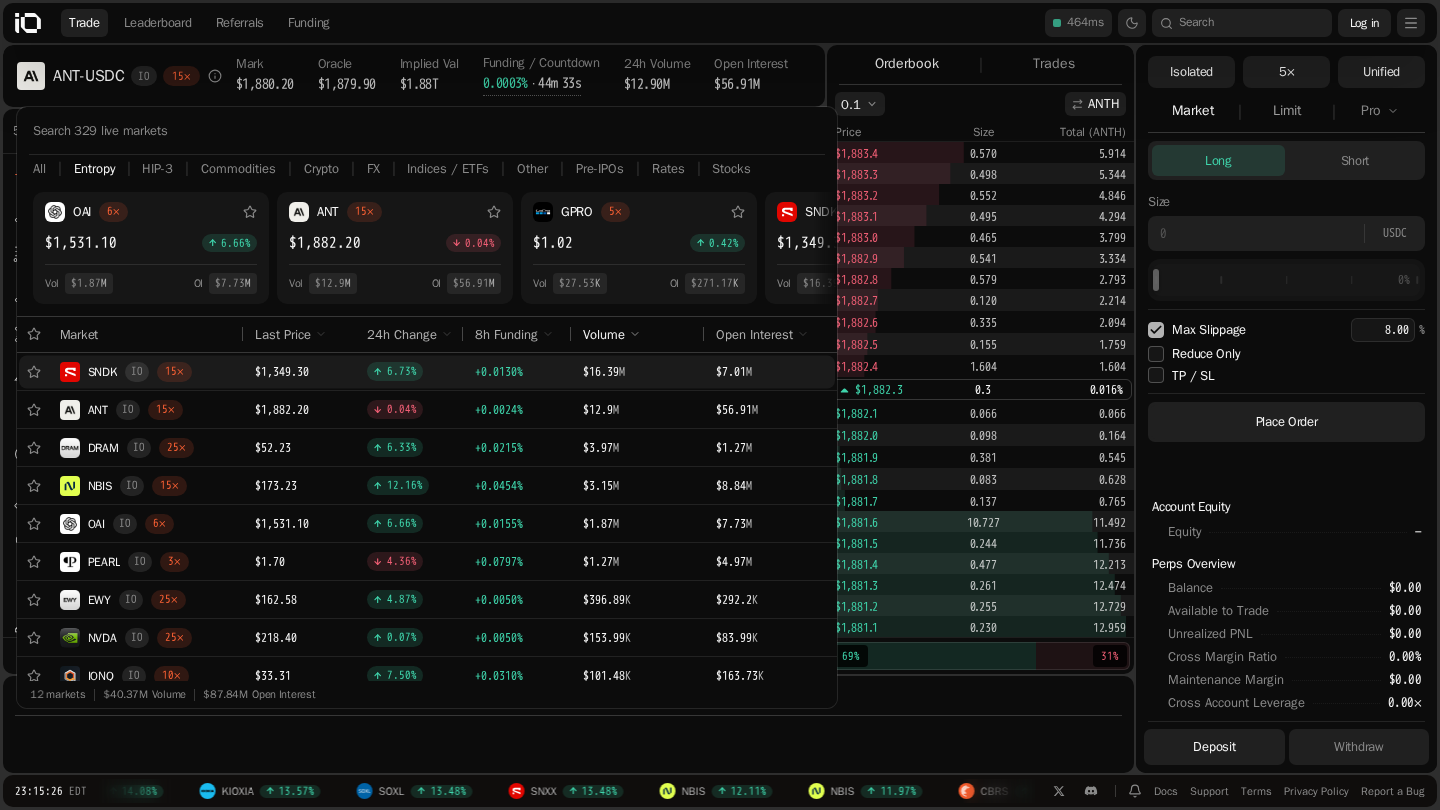
Entropy.io Review (2026): Markets, Trading Tools, Fees, and Risks
A hands-on look at Entropy.io’s public trading interface, with screenshots of pre-IPO, stock and ETF markets, plus fees, risks and competitors.

Author
Akita Inu
Akita Inu covers fast-moving crypto market updates, exchange news, and token ecosystem developments for CoinLive, with a focus on concise source-led reporting.